

Authentic CHFM Dumps With 100% Passing Rate Practice Tests Dumps
Medical Professional CHFM Real Exam Questions Guaranteed Updated Dump from Prep4pass
NEW QUESTION # 21
The initial cost of installing a building automation system is primarily a function of the
- A. specific vendor selected.
- B. gross sq. ft. of the facility.
- C. number of data points monitored or controlled.
- D. technology employed within the system.
Answer: C
Explanation:
Building automation system (BAS) costs are based largely on the number of control points (sensors, outputs, and monitored parameters) that must be integrated. The cost is driven by how many signals must be tracked, rather than just the square footage or vendor.
A: Gross square footage can influence scope, but cost scales with monitored points.
B: Vendor may affect pricing, but primary cost driver is point count.
C: Technology choice matters, but the quantity of control points is more significant.
Reference: ASHE/AHA CHFM study materials - Planning, Design, and Construction.
NEW QUESTION # 22
According to OSHA, which of the following is required as part of a lockout/tagout program?
- A. insulated tools
- B. staff training program
- C. flame-resistant clothing
- D. written activity logs
Answer: B
Explanation:
OSHA's Control of Hazardous Energy (Lockout/Tagout) Standard (29 CFR 1910.147) requires that employers implement a staff training program to ensure all affected employees understand energy control procedures. Insulated tools, logs, or clothing may be used in some contexts, but training is mandatory under OSHA.
References: OSHA 29 CFR 1910.147(c)(7) - Employee Training and Communication.
NEW QUESTION # 23
A visual indication that an electrical receptacle is hospital grade is that the receptacle
- A. is tamper-resistant.
- B. is red.
- C. has a green dot.
- D. has a label.
Answer: C
Explanation:
Hospital-grade receptacles, as defined in UL 498 and required under NFPA 99 Health Care Facilities Code, must be marked with a green dot. This identifies receptacles tested for durability, grounding reliability, and retention force.
Red outlets are often tied to emergency power, but that is separate from the "hospital grade" designation.
References: NFPA 99, Chapter 6 (Electrical Systems); UL 498; CHFM Compliance domain.
NEW QUESTION # 24
Which of the following is the best description of the purpose of an Environmental Tour as required by TJC?
- A. establishes failures in building systems
- B. categorizes risk assessments
- C. ensures compliance with TJC standards
- D. identifies hazards
Answer: D
Explanation:
The Joint Commission (TJC) requires hospitals to conduct environmental tours (also called Environment of Care rounds) with the primary purpose of identifying hazards to patients, staff, and visitors. While compliance, risk categorization, and system failures may be evaluated, the main focus is proactive hazard identification to reduce safety risks.
References: The Joint Commission, Environment of Care Standards, EC.04.01.01.
NEW QUESTION # 25
When performing an in-house renovation project in a dietitian's office, members of the project coordination team should include
- A. housekeeping and security.
- B. information technologies and finance.
- C. interior designer and supply chain.
- D. infection prevention and safety.
Answer: D
Explanation:
Any renovation project in a healthcare environment-even in non-clinical spaces like a dietitian's office- requires evaluation of infection control and safety hazards. The Infection Control Risk Assessment (ICRA) process, supported by The Joint Commission and Facility Guidelines Institute (FGI) standards, mandates involvement of infection prevention and safety personnel in planning.
Correct (D): Ensures compliance with infection prevention standards and staff/patient safety during renovation.
Incorrect:
A). housekeeping and security: Important for support but not primary coordinators.
B). interior designer and supply chain: Handle design and material procurement, but not regulatory compliance.
C). information technologies and finance: Important in certain projects, but not relevant for infection/safety planning.
References:
Facility Guidelines Institute (FGI) Guidelines - Renovation planning includes infection control considerations.
The Joint Commission (EC and IC standards) - Requirement for ICRA involvement during construction
/renovation.
AHA/CHFM Candidate Handbook - Planning, Design and Construction domain.
Healthcare Facility Maintenance Management Expert said:
NEW QUESTION # 26
A measured carbon dioxide level of 1,500 ppm in an area of a facility may indicate
- A. humidity/dewpoint problems.
- B. air exchange rates are within design.
- C. lack of outside air.
- D. vehicular exhaust entering the area.
Answer: C
Explanation:
Acceptable indoor CO# concentrations in healthcare facilities are generally expected to remain below 1,000 ppm, as recommended by ASHRAE Standard 62.1 (Ventilation for Acceptable Indoor Air Quality). A reading of 1,500 ppm typically signals inadequate ventilation and insufficient outside air being introduced into the space. This is a direct indicator of poor dilution of indoor contaminants.
Correct: Lack of outside air (C) - High CO# concentrations are directly linked to reduced outside air supply.
Incorrect:
A). Within design - Not correct, since 1,500 ppm exceeds design thresholds.
B). Vehicular exhaust - Would raise CO and NOx levels, not primarily CO#.
D). Humidity/dewpoint - Unrelated to CO# measurement.
References:
ASHRAE 62.1: Ventilation for Acceptable Indoor Air Quality.
CHFM Candidate Handbook - Maintenance and Operations domain: ventilation standards.
________________________________________
NEW QUESTION # 27
To minimize the number of change orders, it is best to have
- A. a qualified construction manager and subcontractors.
- B. complete plans and specifications.
- C. multiple prequalified bidders.
- D. a builder's insurance policy and performance bond.
Answer: B
Explanation:
The primary cause of change orders is incomplete or unclear plans and specifications. Ensuring that drawings and specs are fully developed before bidding reduces ambiguity, scope gaps, and the likelihood of modifications during construction.
A (Correct): Complete plans/specs = fewer change orders.
B: Bonds/policies protect financially but do not reduce change orders.
C: Prequalification ensures capable bidders but doesn't eliminate scope issues.
D: Competent managers/subcontractors help but cannot offset incomplete design docs.
Reference: CHFM Handbook - Planning, Design, and Construction domain.
NEW QUESTION # 28
An electrical transformer has 254 turns in the primary winding and 127 turns in the secondary winding. If a source emf of 220 volts is applied to the primary coil, the value of the voltage available in the secondary coil is
- A. 220.
- B. 110.
- C. 440.
- D. 127.
Answer: B
Explanation:
The transformer voltage ratio is determined by the turns ratio:
#
#
#
#
=
#
#
#
#
V
p
V
s
=
N
p
N
s
#
#
=
#
#
×
127
254
=
220
×
0.5
=
110
volts
V
s
=V
p
×
254
127
=220×0.5=110volts
A). 110 (Correct): Secondary voltage is half of the primary because turns ratio = 0.5.
B). 127: Incorrect, not consistent with ratio.
C). 220: Would occur only if turns ratio = 1.
D). 440: Would occur if secondary had twice as many turns as primary.
References:
NFPA 70: National Electrical Code - Transformer basics.
CHFM Candidate Handbook - Maintenance and Operations (Electrical Systems).
NEW QUESTION # 29
A primary-secondary chilled water system typically has variable volume pumping on the
- A. open loop.
- B. cooling tower loop.
- C. secondary loop.
- D. primary loop.
Answer: C
Explanation:
In a primary-secondary chilled water system, the primary loop is constant volume, supplying chilled water from the chiller plant. The secondary loop uses variable volume pumping to match distribution system load demand efficiently.
A). Secondary loop (Correct): Where variable flow is applied.
B). Open loop: Not a recognized term in this context.
C). Primary loop: Constant flow design.
D). Cooling tower loop: Separate condenser water system, not chilled water distribution.
References:
ASHRAE Handbook - HVAC Systems and Equipment.
AHA/CHFM Candidate Handbook - Maintenance and Operations (HVAC).
________________________________________
NEW QUESTION # 30
A facility manager wants to communicate to leadership the need to replace an old boiler. What is the most critical piece of information that is needed to support the capital budget request?
- A. time frame for replacing the boiler
- B. the size of the existing boiler
- C. the ROI for replacing the boiler
- D. the annual cost to maintain the new boiler
Answer: C
Explanation:
Leadership requires a business case to justify capital expenditures. The Return on Investment (ROI) demonstrates cost savings, efficiency, and risk reduction benefits of replacing the boiler, making it the most critical piece of information. Size, maintenance cost, or timeline support the request, but ROI is decisive for approval.
References: CHFM Handbook - Financial Management, capital budgeting principles.
NEW QUESTION # 31
According to NFPA 13, when replacing standard response sprinkler heads with quick response heads, all heads must be replaced in the entire
- A. corridor.
- B. zone.
- C. building.
- D. compartment.
Answer: D
Explanation:
NFPA 13 (Standard for the Installation of Sprinkler Systems) specifies that quick-response and standard- response sprinklers shall not be mixed within the same compartment. This is to ensure uniformity in activation and discharge characteristics.
A (Compartment): Correct, all heads in a compartment must match type.
B, C, D: NFPA does not require wholesale replacement across zones, buildings, or corridors beyond the compartment.
References: NFPA 13, Section 8.3.3.3.
NEW QUESTION # 32
Which of the following must be included in a written fire procedure or plan?
- A. locations of fire extinguishers
- B. listing of the pull-station locations
- C. method for notifying the fire department
- D. posted evacuation routes
Answer: C
Explanation:
Written fire procedures must include the method for promptly notifying the fire department or emergency response agency, ensuring immediate response to protect life and property. Evacuation routes and equipment locations are important operational elements, but the mandatory code requirement is a defined notification procedure.
References: NFPA 101, Section 4.7; Joint Commission Environment of Care Standards, EC.02.03.01.
NEW QUESTION # 33
Boiler low water cut-offs are designed to stop the
- A. flow of steam.
- B. supply of air.
- C. operation of the burner.
- D. flow of make-up water.
Answer: C
Explanation:
A low-water cut-off is a safety device that shuts down the burner when water level falls below a safe operating point. This prevents catastrophic overheating and potential boiler explosion. It does not stop steam flow, air supply, or water feed; instead, it directly interrupts burner operation.
References: ASME Boiler and Pressure Vessel Code; NFPA 85 (Boiler and Combustion Systems Hazards Code); CHFM Maintenance and Operations domain.
NEW QUESTION # 34
The annual utility bill at a hospital is $1.2M for a 500,000 sq. ft. facility. The current construction project will add 100,000 sq. ft. to the facility. What is the anticipated annual utility budget after the construction project is completed?
- A. $1,440,000
- B. $1,728,000
- C. $1,828,000
- D. $240,000
Answer: A
Explanation:
Step 1: Calculate utility cost per square foot.
$1,200,000 ÷ 500,000 sq. ft. = $2.40 per sq. ft.
Step 2: Calculate new total square footage.
500,000 + 100,000 = 600,000 sq. ft.
Step 3: Projected utility cost.
600,000 × $2.40 = $1,440,000
Thus, the anticipated utility budget after expansion is $1,440,000.
References:
AHA/ASHE: CHFM Exam Review - Financial Management Calculations.
NEW QUESTION # 35
Which of the following building fire alarm system components is required to be tested quarterly?
- A. water flow devices
- B. duct detectors
- C. supervisory signal devices
- D. door electromechanical releasing devices
Answer: A
Explanation:
According to NFPA 72: National Fire Alarm and Signaling Code, the following frequencies apply:
Waterflow devices (D): Must be tested quarterly.
Supervisory signal devices: Semiannual testing.
Duct detectors and door holders: Tested annually.
Thus, only water flow devices require quarterly testing.
References:
NFPA 72: National Fire Alarm and Signaling Code, Table 14.4.3.2.
The Joint Commission, Environment of Care Standards - Fire alarm system maintenance/testing.
CHFM Candidate Handbook - Compliance domain.
NEW QUESTION # 36
An emergency generator consumes 25 gallons of fuel per hour at peak load. The same hospital uses a boiler that consumes 35 gallons of fuel per hour. What capacity fuel tank is needed to operate both for 72 hours?
- A. 1,800 gallons
- B. 3,600 gallons
- C. 2,520 gallons
- D. 4,320 gallons
Answer: D
Explanation:
Fuel requirements for emergency systems are determined by calculating total consumption per hour multiplied by the required operating duration.
Generator: 25 gallons/hour
Boiler: 35 gallons/hour
Total consumption per hour = 25 + 35 = 60 gallons/hour
For 72 hours: 60 × 72 = 4,320 gallons
Therefore, the fuel tank must have at least 4,320 gallons capacity to meet the 72-hour requirement.
Correct Answer (D. 4,320 gallons).
Other options are underestimations of total combined consumption and would not meet compliance with CMS and NFPA 110 standards, which require hospitals to maintain a 72-hour supply of fuel for emergency power and critical operations.
References:
NFPA 110: Standard for Emergency and Standby Power Systems - 72-hour minimum fuel supply requirement for healthcare facilities.
Centers for Medicare and Medicaid Services (CMS), Emergency Preparedness Final Rule - Essential fuel supply requirements.
American Hospital Association, CHFM Candidate Handbook - Maintenance and Operations domain includes calculations for utility and emergency power requirements.
NEW QUESTION # 37
A hospital is required to have what class of essential electrical system installed?
- A. Type B
- B. Type 1
- C. Type 2
- D. Type A
Answer: B
Explanation:
Hospitals must have a Type 1 Essential Electrical System (EES) as required by NFPA 99. Type 1 systems provide at least two separate branches: the Life Safety branch and the Critical branch, ensuring continuous power to essential life support, patient care, and safety functions during utility outages.
Type 2 systems (for smaller facilities) have fewer requirements.
Type A and B are not classifications under NFPA 99.
References: NFPA 99, Chapter 6 (Electrical Systems, Essential Electrical Systems); CHFM Handbook - Compliance domain.
NEW QUESTION # 38
The time that materials or assemblies have withstood a fire exposure, as established in accordance with test procedures of NFPA 251, is referred to as the
- A. fire resistance rating.
- B. fire protection rating.
- C. flame spread rating.
- D. fire assembly rating.
Answer: A
Explanation:
According to NFPA 251 (Standard Methods of Tests of Fire Resistance of Building Construction and Materials), once a material or assembly is tested and a measure of time is obtained, that result is defined as the fire resistance rating. This rating expresses the duration that a building element can withstand a standardized fire exposure while maintaining structural integrity.
* Correct Answer (B. fire resistance rating): NFPA 251 specifically defines this as the time result from fire exposure testing. It applies to walls, floors, and structural assemblies.
* Incorrect Options:
* A. flame spread rating: This measures only the surface burning characteristics of materials, determined using ASTM E84 or UL 723, not the endurance of an entire assembly.
* C. fire assembly rating: This is not an officially recognized NFPA term; the proper terminology is fire resistance rating.
* D. fire protection rating: This applies to opening protectives such as doors, windows, or shutters, which are tested using NFPA 252 or NFPA 257, not NFPA 251. Fire protection ratings are distinct from fire resistance ratings, since they do not measure full structural endurance.
Relevance to CHFM Compliance Domain:
The Certified Health Care Facility Manager (CHFM) exam includes compliance with fire and life safety codes under its "Compliance" content area. The CHFM Candidate Handbook emphasizes the requirement to understand and apply NFPA standards in healthcare facilities, ensuring compliance with regulatory fire safety measures such as those defined in NFPA 251.
References:
NFPA 251: Standard Methods of Tests of Fire Resistance of Building Construction and Materials - Definition of "fire resistance rating." NFPA: Fire-Protection Ratings and Fire-Resistance Ratings-What's the Difference? - Clarification between assemblies (fire resistance) and openings (fire protection).
NFPA: Construction Types and Material Combustibility - Explanation of flame spread index under ASTM E84/UL 723.
American Hospital Association (AHA), CHFM Candidate Handbook - Exam Content Outline, Compliance domain, which includes NFPA fire safety requirements.
NEW QUESTION # 39
The cost to replace an aging chiller should be part of an organization's
- A. operating budget.
- B. depreciation fund.
- C. capital budget.
- D. project fund.
Answer: C
Explanation:
Replacement of major building systems (e.g., chillers, boilers, roofs) falls under capital expenditures because these items are large, non-recurring, and add to or extend the life of facility assets. The capital budget accounts for these costs, which are not part of the day-to-day operations budget.
Correct: Capital budget (A) - Covers replacement of major equipment and infrastructure.
Incorrect:
B). Project fund - May finance special projects but not part of standard budgeting categories.
C). Depreciation fund - An accounting mechanism, not typically a direct budget line for replacement.
D). Operating budget - Covers recurring expenses like utilities, maintenance, and repairs, not full replacements.
References:
AHA/ASHE: Health Care Facility Budgeting Guidance.
CHFM Candidate Handbook - Financial Management domain: capital vs. operating budgeting.
NEW QUESTION # 40
Life Safety Code® requires which of the following in an on-call sleep room?
- A. emergency call button
- B. bathroom
- C. smoke alarm
- D. rated door
Answer: C
Explanation:
NFPA 101 (Life Safety Code) requires that on-call sleep rooms provided in healthcare facilities must be protected by single-station smoke alarms or an automatic smoke detection system. This requirement ensures early warning for occupants who may be sleeping and unable to respond as quickly in an emergency.
B: Rated doors may be required in certain hazardous areas but are not the mandated feature for on-call sleep rooms.
C: Emergency call buttons are part of patient care areas, not sleep rooms.
D: Bathrooms are not required by Life Safety Code in on-call rooms.
References: NFPA 101, Section 18/19.7.5.5.
NEW QUESTION # 41
Which of the following would a facility health manager consult to determine the required number of medical gas outlets for a specific location, such as patient rooms or ICU rooms?
- A. ADA Guidelines
- B. NFPA 101 Life Safety Code
- C. The Joint Commission Environment of Care (EOC) Standards
- D. FGI Guidelines for the Design and Construction of Hospitals and Outpatient Facilities
Answer: D
Explanation:
The Facility Guidelines Institute (FGI) Guidelines are the authoritative source that specifies requirements for the design and construction of healthcare facilities. Within these guidelines, the number and type of medical gas outlets required in patient care areas such as intensive care units, operating rooms, and patient rooms are detailed. NFPA 99 governs installation and performance standards for medical gas systems, but the quantities of outlets are determined by the FGI Guidelines, which CHFM candidates are expected to know.
Incorrect Options:
A). NFPA 101 Life Safety Code - Addresses fire and life safety, not medical gas outlet quantities.
C). ADA Guidelines - Focus on accessibility, not medical gas systems.
D). The Joint Commission EOC Standards - Require safe use of systems but do not prescribe outlet numbers.
References:
FGI: Guidelines for Design and Construction of Hospitals and Outpatient Facilities - Medical gas outlet requirements per room type.
NFPA 99: Health Care Facilities Code - Technical standards for installation and testing.
CHFM Candidate Handbook - Planning, Design, and Construction domain.
NEW QUESTION # 42
Fire drills in healthcare occupancies shall include the
- A. transmission of the fire alarm signal and simulation of emergency fire conditions.
- B. evacuation of patients to areas of refuge and evacuation of staff from the building.
- C. transmission of a fire alarm signal and audible alarms on each shift.
- D. evacuation of bedridden and infirmed patients to the adjacent smoke compartment.
Answer: A
Explanation:
NFPA 101 (Life Safety Code, Chapter 18/19.7.1.4) requires healthcare fire drills to include transmission of the fire alarm signal and a simulation of emergency fire conditions, ensuring staff are trained to carry out emergency duties. Full evacuation of patients is not required during drills.
References: NFPA 101, Sections 18/19.7.1.4; The Joint Commission EOC standards.
NEW QUESTION # 43
During an analysis of a recent fire alarm log, a higher-than-normal incidence of construction-related fire alarm activations is discovered. The following tasks must be performed:
The hospital evaluates actions to confirm that they resulted in improvements.
The hospital takes action when it does not achieve or sustain planned improvements.
The facility manager identifies and prioritizes improvement opportunities.
The hospital takes action on improvement priorities.
What is the most effective procedural sequence?
- A. 3, 4, 2, 1
- B. 4, 3, 2, 1
- C. 4, 3, 1, 2
- D. 3, 4, 1, 2
Answer: D
Explanation:
The correct sequence aligns with the Plan-Do-Check-Act (PDCA) cycle of continuous improvement:
Identify and prioritize opportunities (3).
Take action on those priorities (4).
Evaluate to confirm results (1).
Take further action if goals are not sustained (2).
This matches performance improvement processes emphasized in the CHFM Administration domain.
References: AHA/ASHE CHFM Handbook - Administration domain; Joint Commission Performance Improvement standards.
NEW QUESTION # 44
An administrator is considering outsourcing the BioMed function to reduce cost. The low-bid base price for outside annual inspection and testing service is $180,000 with an $80/hr repair labor rate and a $120/hr call-in labor rate. The BioMed department currently has an annual labor budget of $240,000. Assuming an estimate of 600 hours of repair labor and 100 hours of call-in labor, how much will the administrator save annually with the outsourcing option?
- A. $48,000
- B. $80,000
Step-by-Step Calculation:
Current in-house cost: $240,000.
Outsourcing cost:
Base price: $180,000
Repair: 600 hrs × $80/hr = $48,000
Call-in: 100 hrs × $120/hr = $12,000
Total outsourcing = $180,000 + $48,000 + $12,000 = $240,000
Difference: $240,000 - $240,000 = $0 - C. $0
- D. $12,000
Answer: C
Explanation:
The outsourcing scenario matches the current in-house budget exactly; therefore, no savings are achieved.
This type of financial analysis is common in the CHFM Financial Management domain.
NEW QUESTION # 45 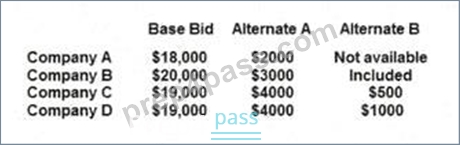
(Base Bid / Alternate A / Alternate B)
Company A: $18,000 / $2,000 / Not available
Company B: $20,000 / $3,000 / Included
Company C: $19,000 / $4,000 / $500
Company D: $19,000 / $4,000 / $1,000
Which company has the LOWEST cost if alternate B is chosen?
- A. Not available # cannot be selected.
- B. $19,000 + $500 = $19,500.
- C. $20,000 + Included ($0) = $20,000.
- D. $19,000 + $1,000 = $20,000.
Answer: B
Explanation:
When Alternate B is chosen, total price = Base Bid + price for Alternate B (or zero if "Included").
Lowest total = $19,500 (Company C).
References:
AHA/CHFM Exam Content Outline - Planning, Design, and Construction domain (procurement/bid evaluations and alternates).
ASHE Project Management guidance - Evaluating base bids with alternates.
NEW QUESTION # 46
......
Verified Pass CHFM Exam in First Attempt Guaranteed: https://www.prep4pass.com/CHFM_exam-braindumps.html
Free CHFM Sample Questions and 100% Cover Real Exam Questions: https://drive.google.com/open?id=1iiZvYaTry4nEy93PNQHFripfbKa-MpEC
