

CTFL_Syll_4.0 Dumps for Pass Guaranteed - Pass CTFL_Syll_4.0 Exam 2024
CTFL_Syll_4.0 Exam Dumps - Try Best CTFL_Syll_4.0 Exam Questions from Training Expert Prep4pass
NEW QUESTION # 75
Which of the following statements describes regression testing?
I) Retesting of a fixed defect
II) Testing of an already tested program
III) Testing of new functionality in a program
IV) Regression testing applies only to functional testing
V) Tests that do not nave to be repeatable, because They are only used once
- A. I, III, IV
- B. II
- C. II, IV, V
- D. I, IV
Answer: B
Explanation:
Regression testing is the re-running of functional and non-functional tests to ensure that previously developed and tested software still performs as expected after a change1 It does not involve retesting of a fixed defect, testing of new functionality, or applying only to functional testing. Tests that are used for regression testing should be repeatable, because they are used to verify the stability of the software after each change2 Reference = ISTQB Certified Tester Foundation Level (CTFL) v4.0 Syllabus, Chapter 4, Section 4.2.2, Page 291; ISTQB Glossary of Testing Terms v4.0, Page 292
NEW QUESTION # 76
Which sequence of state transitions is INCORRECT in accordance with the following description?
To provide for disaster recovery a system (designated as A) has been provided with a backup system (designated as B). Only one of them can be active at a time. When A goes down, B becomes active. When A comes back up then B becomes inactive and A becomes active again. However, when A is down and B also goes down then a message is sent to the system administrator. After this once A comes back up, A becomes active or if B comes up then B becomes Active.
- A. A is active and B is inactive then A goes down, B becomes active.
- B. A comes up when B is active and A was down. Now A becomes active and B becomes inactive.
- C. A is active and B is inactive. A goes down. B becomes active then B goes down. A is made active
- D. A and B are both down then A and B both come back up at the same time. A should become the active system and B should be inactive
Answer: D
Explanation:
According to the description provided, when both systems A and B come back up at the same time, the process should involve a decision about which system should become active. However, the description states that if both systems come up simultaneously, one should become active based on a specific condition or precedence. Generally, in disaster recovery systems, there are protocols to avoid both systems becoming active simultaneously to prevent conflicts. Therefore, the transition where both A and B come back up at the same time and A becomes active while B becomes inactive without any conflict or decision-making step is incorrect.
NEW QUESTION # 77
Mark the correct sentences:
* Defects are a result of environmental conditions and are also referred to as "Failures"
* A human mistake may produce a defect
* A system mil totally fail to operate correctly when a failure exists in it
* When a defect exists in a system it may result in a failure
* Defects occur only as a result of technology changes
- A. IV, V
- B. II, III, IV
- C. II, IV
- D. I, II
Answer: C
Explanation:
* The question is about marking the correct sentences among the given statements related to defects, failures, and mistakes. According to the ISTQB glossary, the definitions of these terms are1:
* Defect: A flaw in a component or system that can cause the component or system to fail to perform its required function, e.g. an incorrect statement or data definition. A defect, if encountered during execution, may cause a failure of the component or system.
* Failure: An event in which a component or system does not perform a required function within specified limits.
* Mistake: A human action that produces an incorrect result.
* Therefore, out of the five given statements, only two are correct, namely:
* A human mistake may produce a defect: This is true, as a mistake is a source or cause of a defect, e.g. a programmer may make a mistake in writing a code statement, which results in a defect in the software component.
* When a defect exists in a system it may result in a failure: This is true, as a defect is a potential or actual cause of a failure, e.g. a defect in the software component may cause the system to fail to perform a required function when the defect is encountered during execution.
* The other three statements are incorrect, namely:
* Defects are a result of environmental conditions and are also referred to as "Failures": This is false, as defects are not a result of environmental conditions, but of mistakes or other factors, and defects are not the same as failures, but rather the causes of failures.
* A system will totally fail to operate correctly when a failure exists in it: This is false, as a system may not necessarily fail completely or stop operating when a failure occurs, but may continue to operate with reduced functionality or performance, or with incorrect results.
* Defects occur only as a result of technology changes: This is false, as defects can occur due to various reasons, not only technology changes, such as human mistakes, design flaws, requirement changes, hardware failures, etc.
References:
* 1: ISTQB Glossary of Testing Terms 4.0, 2023, available at ISTQB) and ASTQB).
NEW QUESTION # 78
Which of the following statements is CORRECT about White-box testing?
- A. White-box testing helps find defects even when specifications are vague because it takes into account the code.
- B. White-box testing helps find defects because it focuses on defects rather than failures
- C. White-box testing helps find defects because it provides for requirements based coverage
- D. White-box testing helps find defects because they can be used to measure statement coverage
Answer: D
Explanation:
White-box testing, also known as structural testing, involves testing the internal structures or workings of an application, as opposed to its functionality (which is tested by black-box testing). The correct statement about white-box testing is that it helps find defects by measuring aspects such as statement coverage.
* Statement Coverage: White-box testing techniques like statement coverage measure whether each statement in the code has been executed at least once. This helps ensure that all parts of the code are tested and can reveal defects in areas that might not be reached by black-box testing alone.
Other statements are less accurate in the context of white-box testing:
* Specifications being vague: White-box testing is code-focused, not requirement-focused. If specifications are vague, it affects both white-box and black-box testing. The main advantage of white-box testing is that it allows testers to create tests based on the code's structure and logic.
* Requirements-based coverage: This is typically associated with black-box testing, which derives tests from specifications and requirements. White-box testing, on the other hand, derives tests from the code itself.
* Focus on defects rather than failures: Both white-box and black-box testing aim to identify defects, but white-box testing does this through code coverage and examining the code paths directly. It does not focus exclusively on defects rather than failures; it is just another method to identify potential issues.
NEW QUESTION # 79
An application is subjected to a constant load for an extended period of time as part of a performance test.
While running this test, the response time of the application steadily slows down, which results in a requirement not being met. This slowdown is caused by a memory leak where the application code does not properly release some of the dynamically allocated memory when it is no longer needed.
Which of the following statements is true?
- A. The slowdown is a defect the memory leak is a failure
- B. The slowdown is an error the memory leak is a defect
- C. The slowdown is a defect while the memory leak is an error
- D. The slowdown is a failure while the memory leak is a defect
Answer: D
Explanation:
In the ISTQB terminology:
* A defect (also known as a bug or fault) is an issue in the code that can cause a failure.
* A failure is the observable incorrect behavior or output of the software due to a defect.
In this scenario, the memory leak is the defect in the application code that causes the application not to release dynamically allocated memory properly. The observable effect of this defect, which is the slowdown in response time, is considered a failure because it is the manifestation of the defect that prevents the application from meeting its performance requirements.
NEW QUESTION # 80
In a review, which of the following is the responsibility of the manager?
- A. Ensuring that sufficient time is available for review
- B. Organizing the logistics of the review meeting
- C. Measuring the performance of each reviewer
- D. Performing detailed review based on past experience
Answer: A
Explanation:
In a review process, the manager's responsibility is to ensure that sufficient time is allocated for the review activities. This includes planning and scheduling the review sessions, making sure that the team has enough time to conduct a thorough and effective review.
References:
* ISTQB CTFL Syllabus V4.0, Section 3.2.3 on the roles and responsibilities in a review process, specifically mentioning the manager's role in ensuring adequate time for reviews.
NEW QUESTION # 81
What does the "absence-of-defects fallacy" refer to in software development?
- A. A misconception that software verification is unnecessary
- B. The idea that fixing defects is NOT important to meeting user needs.
- C. The belief that thoroughly testing all requirements guarantees system success.
- D. The need for constant system quality assurance and improvements.
Answer: C
Explanation:
The "absence-of-defects fallacy" in software development refers to the mistaken belief that if a software system has been thoroughly tested and all requirements have been met without any defects, it guarantees the success of the system. However, this is not necessarily true. Even if no defects are found, the system might still fail to meet the user's needs or business objectives. This fallacy highlights the importance of validation in addition to verification to ensure that the system fulfills the intended use and requirements.
NEW QUESTION # 82
Which of the following statements is not correct?
- A. Testing is often seen as a destructive activity instead of constructive activity
- B. Looking for defects in a system may require Ignoring system details
- C. Looking for defects in system requires professional pessimism and curiosity
- D. Identifying defects may be perceived as criticism against product
Answer: B
Explanation:
Looking for defects in a system does not require ignoring system details, but rather paying attention to them and understanding how they affect the system's quality, functionality, and usability. Ignoring system details could lead to missing important defects or testing irrelevant aspects of the system.
Identifying defects may be perceived as criticism against product, especially by the developers or stakeholders who are invested in the product's success. However, identifying defects is not meant to be a personal attack, but rather a constructive feedback that helps to improve the product and ensure its alignment with the requirements and expectations of the users and clients.
Looking for defects in system requires professional pessimism and curiosity, as testers need to anticipate and explore the possible ways that the system could fail, malfunction, or behave unexpectedly. Professional pessimism means being skeptical and critical of the system's quality and reliability, while curiosity means being eager and interested in finding out the root causes and consequences of the defects.
Testing is often seen as a destructive activity instead of constructive activity, as it involves finding and reporting the flaws and weaknesses of the system, rather than creating or enhancing it. However, testing is actually a constructive activity, as it contributes to the system's improvement, verification, validation, and optimization, and ultimately to the delivery of a high-quality product that meets the needs and expectations of the users and clients.
NEW QUESTION # 83
Consider the following defect report for an Exam Booking System
Defect ID: ST1041 | Title: Unable to cancel an exam booking | Severity: Very High | Priority: Very High | Environment: Windows 10, Firefox Description: When attempting to cancel an exam booking using the cancel exam feature, the system does not cancel the exam even though it shows a message that the exam has been cancelled.
Which ONE of the following indicates the information that should be added to the description for reproducing the defect easily?
- A. Providing exact steps that lead to this defect. It is not clear from the description if this is a problem for any scheduled exam or for a specific user.
- B. Repeating the test case with different browsers and logging a separate defect for each one of them
- C. Providing better severity and priority. It is not clear why this is a high severity problem as the exams can be booked without any problem.
- D. The defect Id used is alphanumeric in nature. It should be a number only.
Answer: A
Explanation:
To reproduce a defect easily, the defect report should include detailed steps that clearly describe how to encounter the issue. This includes the specific actions taken, the expected result, and the actual result observed. In the given defect report, it is not clear if the issue occurs for any scheduled exam or if it is user-specific. Providing exact steps helps developers and testers replicate the issue and understand its context better, leading to quicker and more effective resolution.
NEW QUESTION # 84
Which of the following is a test-first approach, where tests that express a shared understanding from stakeholders of how the application is expected to work, are first written in business-readable language (following the Given/When/Then format), and then made executable to drive development?
- A. Domain-Driven Design (DDD)
- B. Acceptance Test-Driven Development (ATDD)
- C. Test-Driven Development (TDD)
- D. Behavior-Driven Development (BDD)
Answer: D
Explanation:
This answer is correct because Behavior-Driven Development (BDD) is a test-first approach, where tests that express a shared understanding from stakeholders of how the application is expected to work, are first written in business-readable language (following the Given/When/Then format), and then made executable to drive development. BDD is a collaborative approach that involves testers, developers, business analysts, product owners, and other stakeholders in defining the expected behavior of the application using scenarios that describe the preconditions, actions, and outcomes of the application. BDD scenarios are written using a domain-specific language (DSL) that can be translated into executable test cases using tools such as Cucumber or SpecFlow. BDD aims to improve communication, collaboration, and feedback among the team members, and to deliver software that meets the customer's needs and expectations. References: ISTQB Glossary of Testing Terms v4.0, ISTQB Foundation Level Syllabus v4.0, Section 3.1.1.4
NEW QUESTION # 85
The whole-team approach:
- A. promotes the idea that all team members should be responsible for the quality of the product
- B. promotes the idea that all team members should have a thorough understanding of test techniques
- C. is a consensus-based approach that engages the whole team in estimating the user stories
- D. is mostly adopted in projects aimed at developing safety-critical systems, as it ensures the highest level of testing independence
Answer: A
Explanation:
This answer is correct because the whole-team approach is a way of working in agile projects where all team members share the responsibility for the quality of the product, and collaborate on delivering value to the customer. The whole-team approach involves testers, developers, business analysts, product owners, and other stakeholders in planning, designing, developing, testing, and delivering the product. The whole-team approach fosters communication, feedback, learning, and continuous improvement within the team. References: ISTQB Glossary of Testing Terms v4.0, ISTQB Foundation Level Syllabus v4.0, Section 3.1.1.1
NEW QUESTION # 86
Which of the following statements about the value of maintaining traceability between the test basis and test work products is not true?
- A. Traceability can be useful for determining how many test basis items are covered by the corresponding tests
- B. Traceability can be useful to support the needs required by the auditing of testing
- C. Traceability can be useful for assessing the impact of a change to a test basis item on the corresponding tests
- D. Traceability can be useful for determining the most suitable test techniques to be used in a testing project
Answer: D
Explanation:
Traceability is the ability to trace the relationships between the items of the test basis, such as the requirements, the design, the risks, etc., and the test artifacts, such as the test cases, the test results, the defects, etc. Traceability can provide various benefits for the testing process, such as improving the test coverage, the test quality, the test efficiency, and the test communication. However, not all the statements given are true about the value of maintaining traceability between the test basis and test work products. The statement that is not true is option C, which says that test objectives should be the same for all test levels, although the number of tests designed at various levels can vary significantly. This statement is false, because test objectives are the goals or the purposes of testing, which can vary depending on the test level, the test type, the test technique, the test environment, the test stakeholder, etc. Test objectives can be defined in terms of the test basis, the test coverage, the test quality, the test risk, the test cost, the test time, etc. Test objectives should be specific, measurable, achievable, relevant, and time-bound, and they should be aligned with the project objectives and the quality characteristics. Test objectives should not be the same for all test levels, as different test levels have different focuses, scopes, and perspectives of testing, such as component testing, integration testing, system testing, and acceptance testing. The other statements are true about the value of maintaining traceability between the test basis and test work products, such as:
Traceability can be useful for assessing the impact of a change to a test basis item on the corresponding tests: This statement is true, because traceability can help to identify which tests are affected by a change in the test basis, such as a new requirement, a modified design, a revised risk, etc., and to determine the necessary actions to update, re-execute, or re-evaluate the tests. Traceability can also help to estimate the effort, the cost, and the time needed to implement the change and to verify its impact on the software system.
Traceability can be useful for determining how many test basis items are covered by the corresponding tests: This statement is true, because traceability can help to measure the test coverage, which is the degree to which the test basis is exercised by the test cases. Traceability can help to identify which test basis items are covered, partially covered, or not covered by the tests, and to evaluate the adequacy, the completeness, and the effectiveness of the testing process. Traceability can also help to identify the gaps, the overlaps, or the redundancies in the test coverage, and to prioritize, optimize, or improve the test cases.
Traceability can be useful to support the needs required by the auditing of testing: This statement is true, because traceability can help to provide evidence, documentation, and justification for the testing activities, results, and outcomes. Traceability can help to demonstrate that the testing process follows the standards, the regulations, the policies, and the best practices that are applicable to the software system, the project, or the organization. Traceability can also help to verify that the testing process meets the expectations, the needs, and the satisfaction of the users and the stakeholders. Reference: ISTQB Certified Tester Foundation Level (CTFL) v4.0 sources and documents:
ISTQB® Certified Tester Foundation Level Syllabus v4.0, Chapter 1.2.2, Testing Policies, Strategies, and Test Approaches1 ISTQB® Certified Tester Foundation Level Syllabus v4.0, Chapter 2.1.1, Test Planning1 ISTQB® Certified Tester Foundation Level Syllabus v4.0, Chapter 2.1.2, Test Monitoring and Control1 ISTQB® Certified Tester Foundation Level Syllabus v4.0, Chapter 2.1.3, Test Analysis and Design1 ISTQB® Glossary of Testing Terms v4.0, Traceability, Test Basis, Test Artifact, Test Objective, Test Level, Test Coverage, Test Quality, Test Risk, Test Cost, Test Time2
NEW QUESTION # 87
A system has a self-diagnostics module that starts executing after the system is reset. The diagnostics are running 12 different tests on the systems memory hardware. The following is one of the requirements set for the diagnostics module:
'The time taking the diagnostics tests to execute shall be less than 2 seconds' Which of the following is a failure related to the specified requirement?
- A. The diagnostic tests fail to start after a system reset
- B. The diagnostic tests fail due to incorrect implementation of the test code
- C. The diagnostic tests take too much time to execute
- D. The diagnostic tests that measure the speed of the memory, fail
Answer: C
Explanation:
A failure is an event in which a component or system does not perform a required function within specified limits1. A requirement is a condition or capability needed by a user to solve a problem or achieve an objective2. In this case, the requirement is that the diagnostics tests should execute in less than 2 seconds.
Therefore, any event that violates this requirement is a failure. The only option that clearly violates this requirement is B. The diagnostic tests take too much time to execute. If the diagnostic tests take more than 2 seconds to complete, then they do not meet the specified limit and thus fail. The other options are not necessarily failures related to the specified requirement. Option A. The diagnostic tests fail to start after a system reset is a failure, but not related to the time limit. It is related to the functionality of the self-diagnostics module. Option C. The diagnostic tests that measure the speed of the memory, fail is also a failure, but not related to the time limit. It is related to the accuracy of the memory tests. Option D. The diagnostic tests fail due to incorrect implementation of the test code is also a failure, but not related to the time limit. It is related to the quality of the test code. References = ISTQB Certified Tester Foundation Level Syllabus v4.0, Requirements Engineering Fundamentals.
NEW QUESTION # 88
Which of the following is the main difference between quality assurance (QA) and quality control (QC)?
- A. QA is a process-oriented approach, while QC is a product-oriented approach.
- B. QA is preventive, while QC is corrective.
- C. QA is the responsibility of everyone on a project, while QC is the responsibility of a dedicated team.
- D. QA is focused on implementation, while QC is focused on improvement.
Answer: A
Explanation:
Quality Assurance (QA) and Quality Control (QC) are both essential aspects of a comprehensive quality management system but they serve different purposes:
* Quality Assurance (QA): QA is a process-oriented approach that focuses on preventing defects by improving the processes used to develop and test products. It involves setting up processes, methodologies, and standards to ensure that the product meets quality requirements.
* Quality Control (QC): QC is a product-oriented approach that focuses on identifying defects in the final products. It involves activities such as inspection, testing, and review to ensure that the product meets the specified requirements and standards.
Thus, the main difference is that QA is process-oriented and preventive, while QC is product-oriented and corrective.
NEW QUESTION # 89
Mark the correct sentences:
* Defects are a result of environmental conditions and are also referred to as "Failures"
* A human mistake may produce a defect
* A system mil totally fail to operate correctly when a failure exists in it
* When a defect exists in a system it may result in a failure
* Defects occur only as a result of technology changes
- A. IV, V
- B. II, III, IV
- C. II, IV
- D. I, II
Answer: C
Explanation:
The question is about marking the correct sentences among the given statements related to defects, failures, and mistakes. According to the ISTQB glossary, the definitions of these terms are1:
Defect: A flaw in a component or system that can cause the component or system to fail to perform its required function, e.g. an incorrect statement or data definition. A defect, if encountered during execution, may cause a failure of the component or system.
Failure: An event in which a component or system does not perform a required function within specified limits.
Mistake: A human action that produces an incorrect result.
Therefore, out of the five given statements, only two are correct, namely:
A human mistake may produce a defect: This is true, as a mistake is a source or cause of a defect, e.g. a programmer may make a mistake in writing a code statement, which results in a defect in the software component.
When a defect exists in a system it may result in a failure: This is true, as a defect is a potential or actual cause of a failure, e.g. a defect in the software component may cause the system to fail to perform a required function when the defect is encountered during execution.
The other three statements are incorrect, namely:
Defects are a result of environmental conditions and are also referred to as "Failures": This is false, as defects are not a result of environmental conditions, but of mistakes or other factors, and defects are not the same as failures, but rather the causes of failures.
A system will totally fail to operate correctly when a failure exists in it: This is false, as a system may not necessarily fail completely or stop operating when a failure occurs, but may continue to operate with reduced functionality or performance, or with incorrect results.
Defects occur only as a result of technology changes: This is false, as defects can occur due to various reasons, not only technology changes, such as human mistakes, design flaws, requirement changes, hardware failures, etc.
Reference:
1: ISTQB Glossary of Testing Terms 4.0, 2023, available at ISTQB) and ASTQB).
NEW QUESTION # 90
Which of the following statements about static testing and dynamic testing is true?
- A. Static testing is usually much less cost-effective than dynamic testing
- B. Both static testing and dynamic testing can be used to highlight issues associated with non-functional characteristics
- C. Unlike dynamic testing, which focuses on detecting potential defects, static testing focuses on detecting failures which may be due to actual defects
- D. Unlike dynamic testing, which can be also performed manually, static testing cannot be performed without specialized tools
Answer: B
Explanation:
This answer is correct because static testing and dynamic testing are both types of testing that can be used to highlight issues associated with non-functional characteristics, such as usability, performance, security, reliability, etc. Static testing is a type of testing that involves the analysis of software work products, such as requirements, design, code, or test cases, without executing them. Dynamic testing is a type of testing that involves the execution of software work products, such as code or test cases, using inputs and verifying outputs. Both static testing and dynamic testing can be applied to different test levels and test types, and can use different test techniques and tools, to evaluate the non-functional characteristics of the software product. References: ISTQB Glossary of Testing Terms v4.0, ISTQB Foundation Level Syllabus v4.0, Section
2.2.1.1, Section 2.2.1.2
NEW QUESTION # 91
The following decision table is used to assist a doctor in determining the drug therapy to prescribe for a patient (aged 6 to 65 years) diagnosed with acute sinusitis. The table consists of three Boolean conditions and six actions: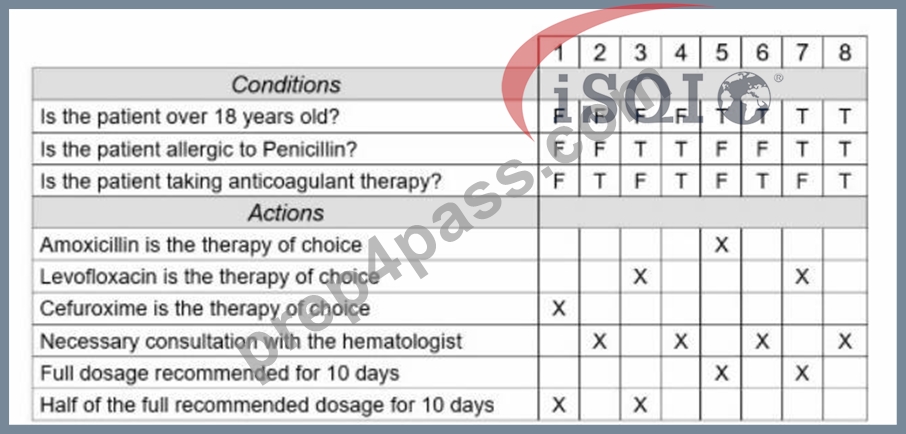
Based only on the given information, which of the following statements is true?
- A. Columns 2, 4. 6 and 8 can be merged into a single column
- B. Column 7 represents an impossible situation and thus can be deleted
- C. Columns 5 and 7 can be merged into a single column
- D. Columns 1 and 3 can be merged into a single column
Answer: B
Explanation:
In the given decision table, Column 7 represents the following conditions and actions:
* The patient is over 18 years old: True
* The patient is allergic to Penicillin: True
* The patient is taking anticoagulant therapy: True
When analyzing this column:
* If the patient is over 18 years old, allergic to Penicillin, and taking anticoagulant therapy, the decision table suggests consultation with a hematologist and prescribing half of the full recommended dosage for
10 days.
This column does not represent an impossible situation based on the conditions provided. However, upon deeper inspection and understanding of medical practices, it can be argued that such a specific combination of conditions could be highly unlikely, making it appear unnecessary or an edge case that might be considered for deletion.
Given the constraints of the conditions and the requirements of the decision table, the provided answer needs to be verified against real-world medical guidelines to confirm if this scenario is indeed impossible or just
NEW QUESTION # 92
The tests at the bottom layer of the test pyramid:
- A. cover larger pieces of functionalities than the tests at the top layer of the pyramid
- B. run faster than the tests at the top layer of the pyramid
- C. are defined as 'Ul Tests' or 'End-To-End tests' in the different models of the pyramid
- D. are unscripted tests produced by experience-based test techniques
Answer: B
Explanation:
Explanation
The tests at the bottom layer of the test pyramid run faster than the tests at the top layer of the pyramid because they are more focused, isolated, and atomic. They usually test individual units or components of the software system, such as classes, methods, or functions. They are also easier to maintain and execute, as they have fewer dependencies and interactions with other parts of the system. The tests at the top layer of the test pyramid, on the other hand, are slower because they cover larger pieces of functionalities, such as user interfaces, workflows, or end-to-end scenarios. They also have more dependencies and interactions with other systems, such as databases, networks, or external services. They are more complex and costly to maintain and execute, as they require more setup and teardown procedures, test data, and test environments. References:
ISTQB Certified Tester Foundation Level (CTFL) v4.0 sources and documents:
ISTQB Certified Tester Foundation Level Syllabus v4.0, Chapter 3.2.1, Test Pyramid1 ISTQB Glossary of Testing Terms v4.0, Test Pyramid2
NEW QUESTION # 93
Which of the following statements is true?
- A. In Agile software development, work product documentation tends to be lightweight and manual tests tend to be often unscripted as they are often produced using experience-based test techniques
- B. In Agile software development, the first iterations are exclusively dedicated to testing activities, as testing will be used to drive development, which will be performed in the subsequent iterations
- C. Both in Agile software development and in sequential development models, such as the V-model, test levels tend to overlap since they do not usually have defined entry and exit criteria
- D. Sequential development models impose the use of systematic test techniques and do not allow the use of experience-based test techniques
Answer: A
Explanation:
Explanation
This answer is correct because in Agile software development, work product documentation, such as user stories, acceptance criteria, or test cases, tends to be lightweight and concise, as the focus is on working software and frequent communication rather than comprehensive documentation. Manual tests tend to be often unscripted, as they are often produced using experience-based test techniques, such as error guessing or exploratory testing, which rely onthe tester's skills, knowledge, and creativity to find defects and provide feedback. References: ISTQB Foundation Level Syllabus v4.0, Section 3.1.1.2, Section 3.2.1.2
NEW QUESTION # 94
......
Latest 100% Passing Guarantee - Brilliant CTFL_Syll_4.0 Exam Questions PDF: https://www.prep4pass.com/CTFL_Syll_4.0_exam-braindumps.html
Practice Examples and Dumps & Tips for 2024 Latest CTFL_Syll_4.0 Valid Tests Dumps: https://drive.google.com/open?id=1gVmlpmSlxehRiAJExhNUMTGBvV6MTXY2
