

Mar-2024 Download Free Latest Exam DEE-1111 Certified Sample Questions
Prepare for your exam certification with our DEE-1111 Certified EMC
NEW QUESTION # 19
A DG group is part of a snapshot schedule which runs each day at 9 am then linked to a set of targets for a full copy after termination. Additional volumes were added which increased the link to full copy time.
What course of action will prevent the issue?
- A. Set copy pace 16
- B. Relink without the -copy option
- C. Set copy to URGENT
- D. Relink with the -precopy option
Answer: D
Explanation:
The -precopy option in the relink command can be used when you want to start copying data to the target devices immediately after the link operation. This can be useful in situations where additional volumes have been added, increasing the link to full copy time. By using -precopy, you ensure that the data starts copying immediately, preventing potential issues.
NEW QUESTION # 20
What is a requirement for the SRDF/Metro devices for an SRDF/Metro personality swap?
- A. Must be in suspended state
- B. Must be RW on the link
- C. Must be in partitioned state
- D. Must be WD on the link
Answer: B
Explanation:
For an SRDF/Metro personality swap, the SRDF/Metro devices must be Read/Write (RW) on the link. This ensures that data can be read from and written to the devices during the swap operation.
NEW QUESTION # 21
An administrator is configuring SYMACL on a PowerMax array.
What are possible ways to get a unique ID for a host system?
- A. Derived from host-based passphrase Randomly generated by Solutions Enabler lockbox file
- B. Derived from storage array hardware configuration From a passphrase
- C. Derived from host hardware configuration Randomly generated
- D. Derived from SAN domain ID Derived from local disk configuration
Answer: A
Explanation:
The SYMACL unique ID for a host system can be obtained in two ways: derived from a host-based passphrase or randomly generated by the Solutions Enabler lockbox file. The host-based passphrase is a string that the user can specify to generate a unique ID for the host. The passphrase can be entered interactively using the symacl -unique -passphrase command, or stored in a file and passed as an argument using the symacl -unique -passphrase -file command. The Solutions Enabler lockbox file is a secure file that stores encryption keys and other sensitive information. The lockbox file can also generate a random unique ID for the host using the symacl -unique command. The lockbox file must be created and initialized before using this method.
Reference:
symacl -unique : Unable to obtain unique ID for host - Dell
EMC - Symmetrix Access Control - symacl | SANSPIRE
How to identify hostname and host ID for license generation
NEW QUESTION # 22
A storage administrator migrated an AIX host using NDM.
When they commit the migration, how is host access to the source array removed?
- A. Source volumes are deleted
- B. Masking view is deleted
- C. Old host paths are set NR
- D. Source volumes are set NR
Answer: B
Explanation:
During a Non-Disruptive Migration (NDM), when the migration is committed, the host access to the source array is removed by deleting the masking view. The masking view is a logical grouping of host initiators, storage ports, and a storage group (which contains volumes). Deleting the masking view removes the host's access to the volumes on the source array12. Reference: Dell EMC PowerMax and VMAX: Non-Disruptive Migration Best Practices and Operational Guide, VMAX/PowerMax Non-Disruptive Migration (NDM) for the IBMi host platform | Dell US Support Knowledge Base Article
NEW QUESTION # 23
An application server has the following data characteristics:
80% of the I/O is generated with 8 KB random small blocks
20% of the I/O is generated with 64 KB sequential large blocks
50% of all I/O is a write
What workload profile do these data characteristics represent?
- A. RWM
- B. OLTP
- C. RRH
- D. DCS
Answer: B
Explanation:
The data characteristics represent an Online Transaction Processing (OLTP) workload profile. OLTP workloads typically consist of a high percentage of small, random I/O operations2. In this case, 80% of the I/O is generated with 8 KB random small blocks, which is characteristic of OLTP workloads2. Reference: Use DISKSPD to test workload storage performance - Azure Stack HCI | Microsoft Learn
NEW QUESTION # 24
While using DELL EMC Data Erasure on a PowerMax, what is the minimum number of overwrites needed to support compliance with internal policies and regulatory requirements?
- A. 0
- B. 1
- C. 2
- D. 3
Answer: A
Explanation:
While using DELL EMC Data Erasure on a PowerMax, the minimum number of overwrites needed to support compliance with internal policies and regulatory requirements is 3. The application has prompts and notifications. Such as the option to choose the number of Media Eraser 'wipes' (3x times, 5x times or 7x times)1. Reference: Dell EMC Community Network
NEW QUESTION # 25
Refer to the exhibit.
What should be done first to recover from this Concurrent SRDF/Star configuration failure?
- A. Disable Star
- B. Reset the 1st Target Site
- C. Switch to the 1st Target Site
- D. Reset the 2nd Target Site
Answer: C
Explanation:
In a Concurrent SRDF/Star configuration failure, the first step to recover is to switch to the 1st Target Site. This is because in a Concurrent SRDF/Star configuration, there are two target sites and one source site. If there's a failure, the source site can switch to either of the target sites based on the business continuity plan1. Reference: Dell EMC Solutions Enabler 9.2 SRDF Family CLI User Guide
NEW QUESTION # 26
An administrator has added custom SSL certificates. Each time a client connection is made, default certificates are used.
Which step must be completed?
- A. manage server cert update
- B. restart storsrvd
- C. svmcfq discover
- D. security_cert_allow wildcards
Answer: B
Explanation:
If an administrator has added custom SSL certificates and each time a client connection is made, default certificates are used, then 'restart storsrvd' must be completed. This is because changes to SSL certificates often require a restart of the service that uses them in order for the new certificates to be correctly loaded and used for future client connections1.
NEW QUESTION # 27
What is the correct sequence of steps to configure and bring up an SRDF/Star environment?
Answer:
Explanation:
1 - Verify SRDF/Star control host connectivity and array settings
2 - Enable SRDF/Star configuration
3 - Add BCV devices to the SRDF/Star configuration
4 - Create an SRDF/Star composite group and options file
5 - Perform the symstar setup operation and create composite groups on target sites Reference:
Dell EMC Solutions Enabler 9.2 SRDF Family CLI User Guide
NEW QUESTION # 28
Which external storage can be connected to PowerMax using DX emulation?
- A. Compellent
- B. PowerStore
- C. Unity
- D. Data Domain
Answer: D
Explanation:
Data Domain is the only external storage that can be connected to PowerMax using DX emulation. DX emulation is a specialized back-end DA emulation that handles SAN attached disks. DX directors are configured on existing PowerMax front-end Fibre Channel ports and are required to be implemented in pairs for high availability. DX emulation is used to support ProtectPoint technology, which integrates primary storage with Data Domain protection storage to accelerate backup and recovery. Therefore, answer A is correct1.
B, C, and D are incorrect because they are not external storage that can be connected to PowerMax using DX emulation. Unity (B), PowerStore , and Compellent (D) are primary storage arrays that do not support ProtectPoint technology or DX emulation.
NEW QUESTION # 29
What is the maximum number of SCM RAID groups that can be added to a two-engine PowerMax 2000?
- A. 0
- B. 1
- C. 2
- D. 3
Answer: A
Explanation:
the maximum number of SCM RAID groups that can be added to a two-engine PowerMax 2000 would depend on various factors including the specific configuration of the system and the capacity requirements.
NEW QUESTION # 30
An SRDF/Metro device pair was in an ActiveActive state. A link failure between arrays occurs. The application continues running on the R1 side, and the link failure is addressed.
What is the current state of the Metro device pair?
- A. Partitioned
- B. Active Active
- C. Active Bias
- D. Suspended
Answer: C
Explanation:
An SRDF/Metro device pair was in an ActiveActive state, meaning that both the R1 and R2 devices were read/write accessible to the host or hosts. A link failure between arrays occurs, causing the device pair to become Not Ready (NR) on the SRDF link. SRDF/Metro responds by making the non-biased or R2 paired device inaccessible (not ready) to the host or host cluster, while keeping the biased or R1 paired device accessible (ready). This ensures that there is no data inconsistency or split-brain scenario between the two sites. The device pair enters an Active Bias state, which indicates that only one side of the pair is active and has a bias attribute set. The bias attribute determines which side of the pair remains accessible in case of a link failure. By default, the bias is set to the R1 side of the pair, but it can be changed using the symrdf set bias command. The application continues running on the R1 side, and the link failure is addressed. Once the link is restored, the device pair resumes the ActiveActive state and both devices become accessible again.
Reference:
SRDF/Metro overview
VMware vSphere Metro Storage Cluster (vMSC) with Dell PowerMax and Dell EMC VMAX SRDF/Metro Understanding bias
NEW QUESTION # 31
A customer's security administrator needs to configure Access Control.
What must they do prior to performing this operation?
- A. Define the User Access ID for the Admin User
- B. Log in to the host as a member of the AdminGrp
- C. Configure Access Controls for internal system user and Guest OS
- D. Enable SYMACL on the Management Module Control Station
Answer: A
Explanation:
Before configuring Access Control, the security administrator must define the User Access ID for the Admin User. This is a necessary step to ensure that the administrator has the necessary permissions to perform this operation.
PowerMax & VMAX All-Flash Storage Technical Documentation, Dell EMC PowerMax and VMAX All Flash: Embedded Management
NEW QUESTION # 32
A PowerMax storage group is no longer SL compliant. No changes to application I/O profile have occurred.
Which factor is most likely responsible for the SL compliance impact?
- A. Performance thresholds were exceeded
- B. Host queue depth setting was changed
- C. Queue depth full event
- D. Noisy Neighbor issue
Answer: D
Explanation:
A noisy neighbor issue occurs when one or more applications consume more resources than expected, causing performance degradation for other applications. This can affect the SL compliance of a storage group, as the service level defines the expected response time and performance for the applications in that group. If a noisy neighbor consumes too much cache, bandwidth, or CPU cycles, it can cause the SL compliance to drop below the target level. Therefore, answer A is correct.
B, C, and D are incorrect because they are not likely to cause SL compliance impact for a storage group. Queue depth full event (B) is a host-side issue that occurs when the host queue depth is too low or the host I/O rate is too high, causing the host to stop sending I/O requests to the array. Host queue depth setting is also a host-side parameter that determines how many I/O requests can be queued by the host. Performance thresholds (D) are user-defined values that trigger alerts when certain metrics exceed or fall below the specified levels. None of these factors affect the SL compliance of a storage group on the array.
NEW QUESTION # 33
vWitness and Array Witness options are deployed in the same operating environment simultaneously.
Which option does SRDF/Metro favor in this situation?
- A. Array Witness
- B. Device Bias
- C. Smart DR
- D. Witness
Answer: D
Explanation:
When vWitness and Array Witness options are deployed in the same operating environment simultaneously, SRDF/Metro favors the Witness option over the Array Witness option. This is because the Witness option provides a higher level of protection against split-brain scenarios and data loss than the Array Witness option. The Witness option uses a third-party server to monitor the health and connectivity of both SRDF/Metro arrays and to arbitrate in case of a failure. The Array Witness option uses a third array to store configuration information and to arbitrate in case of a failure. However, the Array Witness option does not monitor the health and connectivity of both SRDF/Metro arrays, and it requires manual intervention to resume SRDF/Metro replication after a failure.
NEW QUESTION # 34
A drive failure has occurred at a customer environment, and a service request has been opened with customer support. A drive failure has occurred at a customer environment, and a service request has been opened with customer support.
Order the steps in sequence as part of key management.
Answer:
Explanation:
1 - Spare drive invoked against failed drive
2 - 1st entry in audit log
3 - Sparing operation is completed
4 - Key is deleted from the repository when failed drive is removed
5 - 2nd entry in audit log
6 - Key is generated for replacement drive when installed
Reference:
Dell EMC PowerMax and VMAX All Flash: Data at Rest Encryption
NEW QUESTION # 35
During a Non-Disruptive Migration (NDM), what is the result of issuing the ReadyTgt SYMCLI command to the migrating Storage Group?
- A. Confirms that both the source and target arrays can support IDM operations
- B. Masking View is created on the target array using elements that are created during the create command
- C. Completes the migration by removing the migrated application resources from the source array
- D. Source Masking View is removed so the original source paths are in a dead state
Answer: C
Explanation:
During a Non-Disruptive Migration (NDM), issuing the ReadyTgt SYMCLI command to the migrating Storage Group completes the migration by removing the migrated application resources from the source array2. This command is typically issued after all data has been synchronized from the source to the target array and application I/O has been switched to the target array2. Reference: NDM overview | Dell EMC PowerMax and VMAX: Non-Disruptive Migration Best Practices and Operational Guide | Dell Technologies Info Hub
NEW QUESTION # 36
Refer to the exhibit.
PowerMax A has a current utilization of 10%, and PowerMax B has a current utilization of 70%.
What will the response times be for systems A and B if utilization increases by 10%?
- A. A=10, B=40
- B. A=15, B=50
- C. B=40, A=10
- D. B=15.A=15
Answer: A
Explanation:
If utilization increases by 10% for both systems A and B, where system A has a current utilization of 10% and system B has a current utilization of 70%, the response times for systems A and B would not necessarily increase linearly with utilization. The exact impact on response times would depend on various factors including workload characteristics, system configuration, and resource contention among others34. However, without specific details on these factors, it's not possible to provide an accurate prediction for the new response times. Reference: PowerMax and VMAX All Flash: Storage Resource Pool (SRP) Effective Used Capacity threshold alert, Service levels and eNAS | Dell EMC PowerMax and VMAX All Flash: eNAS Best Practices
NEW QUESTION # 37
An organization has PowerMax systems on three sites. They plan to implement SRDF/Star to provide remote protection.
What is a restriction for an SRDF/Star configuration?
- A. SRDF Groups cannot be shared between SRDF/Star configurations
- B. The asynchronous PowerMax requires twice the SRDF directors compared to the two synchronous arrays
- C. All SRDF/Star device pairs must be of the same geometry and size
- D. All the SRDF Groups must be defined and in suspended state
Answer: C
Explanation:
In an SRDF/Star configuration, all SRDF/Star device pairs must be of the same geometry and size. This is because SRDF/Star uses concurrent SRDF to maintain synchronous and asynchronous SRDF sessions between three arrays. The devices in these sessions must have identical geometry to ensure data consistency56. Reference: Dell EMC Solutions Enabler 9.2 SRDF Family CLI User Guide, SRDF/Metro overview | Dell EMC PowerMax and VMAX All Flash: SRDF/Metro Overview and Best Practices
NEW QUESTION # 38
A company has two PowerMax arrays located 100 km apart. The arrays are configured with SRDF/S over Fibre Channel.
Which Dell EMC technology improves FC replication between sites?
- A. Write Acceleration
- B. Fast Write
- C. SIRT
- D. Deduplication
Answer: B
Explanation:
Fast Write is a Dell EMC technology that improves Fibre Channel (FC) replication between sites in a SRDF/S configuration. When a write I/O is issued by the host to the R1 device, SRDF with Fast Write acknowledges the write to the host as soon as the data is stored in the R1's cache and transmitted to the R2's cache. This results in reduced latency and improved performance for FC replication between sites.
https://www.delltechnologies.com/asset/en-us/products/storage/industry-market/h17118_dell_emc_powermax_family_overview.pdf
https://infohub.delltechnologies.com/l/dell-emc-powermax-and-vmax-all-flash-srdf-metro-overview-and-best-practices-1/srdf-metro-overview/
NEW QUESTION # 39
Refer to exhibit.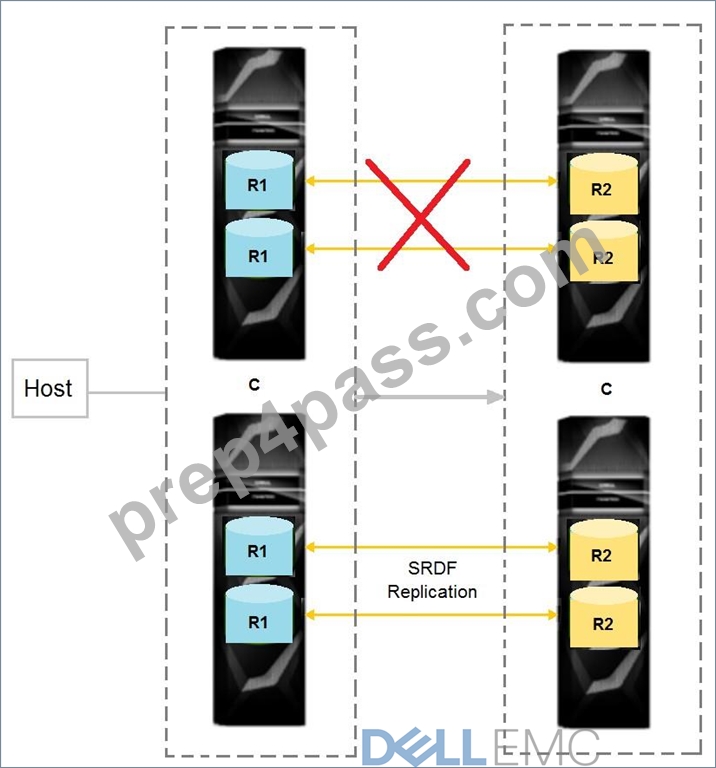
The RDF-ECA timer has expired.
What is the state of all the RDF links?
- A. split
- B. suspend
- C. failed over
- D. online
Answer: B
Explanation:
When the RDF-ECA timer expires, all RDF links will be in a 'Suspend' state. This is because the RDF-ECA timer is used to control how long SRDF waits for an acknowledgement from the remote array before it suspends the link. If an acknowledgement is not received within this time, SRDF assumes that there is a problem with the link or remote array and suspends the link to prevent data loss or corruption.
NEW QUESTION # 40
An administrator implemented SYMACLs on a PowerMax using host-based Access IDs. The administrator is no longer able to run SYMCLI commands against the volumes belonging to a host.
What is a possible reason for this issue?
- A. SYMAPI options file was manually modified with the wrong host ID.
- B. symacl -unique -passphrase was run using a different passphrase
- C. The disks the volumes were on were replaced
- D. Host network interface card was replaced
Answer: A
Explanation:
If an administrator implemented SYMACLs on a PowerMax using host-based Access IDs and is no longer able to run SYMCLI commands against the volumes belonging to a host, one possible reason could be that the SYMAPI options file was manually modified with the wrong host ID. The SYMAPI options file contains configuration settings for Solutions Enabler, including host IDs for access control. If this file is incorrectly modified, it could prevent the administrator from running SYMCLI commands against certain volumes34. Reference: Dell EMC PowerMax and VMAX All Flash: Embedded Management, Role Based Access Control on PowerMax - Storage Intelligence
NEW QUESTION # 41
......
EMC DEE-1111 expert certification ensures that IT professionals have the necessary skills and knowledge required to deploy, manage, and troubleshoot EMC’s PowerMax and VMAX family solutions. Dell EMC Education Services offer comprehensive training programs that cover all aspects of these solutions, including hardware, software, and management. Additionally, participants will gain experience in performance tuning, data replication, and disaster recovery, among other important aspects of data storage.
EMC DEE-1111 exam covers a wide range of topics related to PowerMax and VMAX storage solutions, including hardware and software components, configuration and management of storage arrays, data protection and disaster recovery, and performance optimization techniques. DEE-1111 exam also tests the candidate's knowledge of advanced features such as automated tiering, data compression, and storage virtualization.
EMC DEE-1111 (Expert - PowerMax and VMAX Family Solutions) Exam is an industry-recognized certification that validates the skills and knowledge of IT professionals in managing and deploying storage solutions using EMC PowerMax and VMAX families. DEE-1111 exam is designed to test the candidate's understanding of the features and functionalities of these storage solutions and their ability to implement and maintain them in complex enterprise environments.
Free EMC DEE-1111 Exam 2024 Practice Materials Collection: https://www.prep4pass.com/DEE-1111_exam-braindumps.html
DEE-1111 Exam Info and Free Practice Test All-in-One Exam Guide Mar-2024: https://drive.google.com/open?id=1e39k_2KP832K978uN8FI_hbH__ulK-3X
