

[Nov 23, 2025] New XSIAM-Engineer Exam Dumps with High Passing Rate
Get XSIAM-Engineer Braindumps & XSIAM-Engineer Real Exam Questions
NEW QUESTION # 84
A large enterprise is migrating its legacy SIEM to Palo Alto Networks XSIAM. The security operations center (SOC) currently uses a proprietary threat intelligence platform (TIP) and an incident response (IR) ticketing system. The goal is to automate the ingestion of threat intelligence into XSIAM and the creation of IR tickets for high-fidelity alerts. Which of the following XSIAM automation planning considerations is paramount to ensure seamless data flow and avoid alert fatigue?
- A. Defining a comprehensive schema mapping between the TIP's data fields and XSIAM's Common Information Model (CIM) for automatic correlation.
- B. Prioritizing the integration with the IR ticketing system over the TIP, as incident response is more critical.
- C. Developing custom Python scripts for each individual threat indicator instead of using XSIAM's native playbooks.
- D. Limiting the number of automated playbooks to avoid overwhelming the XSIAM engine.
- E. Implementing a daily manual review process for all ingested threat intelligence before XSIAM processes it.
Answer: A
Explanation:
For seamless data flow and to avoid alert fatigue, defining a comprehensive schema mapping between external data sources (like a TIP) and XSIAM's Common Information Model (CIM) is crucial. This ensures that threat intelligence is correctly parsed, correlated, and actionable within XSIAM, enabling accurate alert generation and reducing false positives. Options B, C, D, and E represent less efficient, reactive, or manual approaches that would hinder automation goals.
NEW QUESTION # 85
A large-scale XSIAM deployment is experiencing ingestion bottlenecks and high latency for certain critical data sources, specifically network flow data from dozens of firewalls and identity logs from multiple Active Directory domains. The current architecture uses a single Broker VM for all on-premise integrations. What steps should the XSIAM engineer take to diagnose and alleviate these ingestion performance issues, considering the specific data types involved?
- A. Implement an intermediate Kafka cluster on-premise to buffer all logs before forwarding them to the Broker VM, thus smoothing out ingestion spikes.
- B. Reduce the logging verbosity on the firewalls and Active Directory to decrease the overall volume of data being sent to XSIAM.
- C. Check the XSIAM cloud-side ingestion health metrics; the bottleneck is likely within the XSIAM cloud, not the on-premise components.
- D. Review the Broker VM's resource utilization (CPU, memory, network I/O) from the XSIAM console. For network flow data, consider deploying additional Broker VMS in a load-balanced configuration to distribute the ingestion load. For identity logs, optimize the AD query frequency and data volume transmitted.
- E. Increase the CPU and memory allocated to the single Broker VM, as this is the most common cause of performance bottlenecks for all data types.
Answer: D
Explanation:
Ingestion bottlenecks, especially with high-volume data like network flows and frequent identity updates, often point to resource constraints or architectural limitations of the Broker VM. Option B is the most comprehensive and correct approach: 1. Diagnose: Reviewing the Broker VM's resource utilization (CPU, memory, network I/O) from the XSIAM console is the first critical step. This directly indicates if the Broker VM itself is becoming a bottleneck. 2. Network Flow Data: Network flow data (e.g., NetFlow, IPFIX, firewall session logs) can be extremely high volume. A single Broker VM might be overwhelmed. Deploying additional Broker VMS and distributing the firewall log forwarding across them (load-balancing) is a standard and effective scaling strategy for high-volume data. Each Broker VM can handle a certain throughput. 3. Identity Logs: While generally lower volume than network flows, frequent AD queries for identity updates can still impact performance. Optimizing the AD query frequency (e.g., using change notifications instead of full syncs, or adjusting intervals) and ensuring only necessary data fields are transmitted can significantly reduce the load. Option A: While increasing resources can help, it's a temporary fix if the architecture itself is not scalable for the data volume. It's better to understand the specific bottleneck before just throwing more resources at it. Option C: An intermediate Kafka cluster can help, but it adds complexity and is generally considered if the Broker VM scaling isn't sufficient or if there are extreme burst patterns. It's not the primary or first-line solution for general ingestion bottlenecks with XSIAM Broker VMs. Option D: Reducing logging verbosity should be a last resort, as it directly impacts detection capabilities by removing valuable telemetry. Option E: While XSIAM cloud-side health should always be monitored, the description points to on-premise data sources and a single Broker VM, making the Broker VM a more likely initial point of failure for bottlenecks.
NEW QUESTION # 86
A newly deployed XSIAM indicator rule designed to detect 'Ransomware Activity' is generating an unmanageable number of alerts. The rule broadly looks for 'File Write' events where matches common ransomware extensions (e.g., '.locked', .crypt' , .encrypt' ). Analysis reveals legitimate file encryption tools and development activities are the primary false positive sources. You need to significantly reduce false positives while ensuring high-fidelity detection of actual ransomware. Which combination of XSIAM content optimization techniques would be most effective?
- A. Add a filter to only trigger if the 'file_size' is above IGB, assuming ransomware encrypts large files.
- B. Increase the number of file extensions in the rule to include even more ransomware variants, and set the severity to 'High'.
- C. Implement an exclusion for 'process_name' of known legitimate encryption applications (e.g., 'WinZip.exe', 'GnuPG.exe') from the rule.
- D. Leverage XSIAM's 'Machine Learning' capabilities to identify anomalous file encryption patterns, potentially creating a separate behavioral rule or using built-in XDR analytics for ransomware.
- E. Modify the XQL to correlate File Writes events with suspicious 'Process Creation' events (e.g., 'cmd.exe' executing 'vssadmin delete shadows'), or 'Network Connection' attempts to known C2 infrastructure, within a short time window and by the same user/host.
Answer: C,D,E
Explanation:
To effectively optimize ransomware detection and reduce false positives, a multi-faceted approach is best: B: Correlate with other suspicious activities: This is a cornerstone of high-fidelity detection. Ransomware doesn't just encrypt files; it often performs other malicious actions like deleting shadow copies Cvssadmin delete shadows), making network connections to C2, or attempting to disable security services. Correlating these events with file encryption drastically reduces false positives. C: Exclude legitimate applications: Directly excluding known, legitimate applications (like 'WinZip.exe', that might perform encryption is a simple yet very effective way to eliminate a large class of false positives. D: Leverage Machine Learning/Behavioral Analytics: XSIAM's strength lies in its ML and behavioral analytics. For complex threats like ransomware, these capabilities can identify anomalous patterns of file modification, encryption, and deletion, even without specific IOCs. This complements indicator rules by detecting new or obfuscated variants. This might involve creating a new behavioral rule or relying on existing XDR analytics. Option A would increase false positives. Option E is too simplistic; ransomware affects files of all sizes, and a IGB threshold would miss many attacks.
NEW QUESTION # 87
An advanced persistent threat (APT) group is suspected of targeting a high-value asset within an organization.
The security team wants to establish a real-time, bidirectional integration between XSIAM and their custom-built honeypot system to quickly identify and analyze APT activity.
The honeypot generates highly detailed JSON logs (e.g., attacker IP, commands executed, exploited vulnerabilities) and also offers an API to dynamically update honeypot configurations (e.g., block attacker IP, change honeypot persona).
Which XSIAM integration strategy would enable the most agile detection and response lifecycle, specifically for a high- fidelity, real-time threat scenario, including the code structure for a critical part of the integration?
- A. Honeypot logs are written to a local file, and an XSIAM Collector periodically ingests these files. An XSIAM Correlation Rule detects APT patterns. The response uses a 'Send Email' action to the honeypot admin. Code for API call is not directly applicable in XSIAM.
- B. XSIAM regularly pulls logs from the honeypot via SFTP. XSIAM then sends a notification to a third-party SOAR platform, which orchestrates the honeypot configuration updates. Code structure for XSIAM is limited to basic API calls.
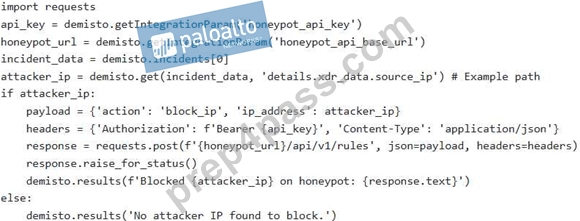
- C. The honeypot pushes JSON logs directly to an XSIAM Event Ingest API endpoint. An XSIAM Content Pack defines the data source and a custom 'Honeypot Incident' type. Upon ingestion, a real-time XSIAM Correlation Rule generates an incident. An XSIAM Playbook, triggered by this incident, contains a 'Code' task (Python script) to interact with the honeypot's API. This Python script should robustly handle API authentication, dynamic parameters, and error handling. For example, dynamically setting a block rule:
- D. The honeypot sends SNMP traps for events to an XSIAM Broker. An XSIAM Playbook uses a 'Run Command' action to execute a shell script on an external server, which then updates the honeypot. Code for API call is external.
Answer: C
Explanation:
For real-time, high-fidelity threat scenarios involving a custom honeypot, direct API integration with dynamic configuration capabilities is crucial. The honeypot pushing JSON logs directly to the XSIAM Event Ingest API endpoint ensures low-latency ingestion. A custom XSIAM Content Pack and Correlation Rule properly categorize and trigger incidents. The most agile response is achieved by an XSIAM Playbook utilizing a 'Code' task (Python script). This allows for highly customized API interactions, including dynamic parameter passing (e.g., the attacker IP from the incident) and robust error handling. The provided code snippet demonstrates fetching incident data, extracting the attacker IP, constructing an API payload, and making a POST request, which is exactly what's needed for dynamic honeypot updates. This approach minimizes external dependencies and keeps the automation within XSIAM for better management and auditing. Option A's generic 'Call API' might lack the flexibility and error handling of a 'Code' task for complex scenarios.
NEW QUESTION # 88
An XSIAM deployment is integrated with an external SOAR platform. The SOAR platform needs to create and update incidents, add notes, and retrieve alert details, but should NOT have permissions to delete incidents or manage XSIAM system settings. What is the most granular and secure approach to configure a dedicated XSIAM role for the SOAR platform's API access?
- A. Provide the SOAR platform with 'Administrator' access, as it simplifies integration and ensures all necessary permissions are present.
- B. Implement a proxy API gateway in front of XSIAM that filters API calls from the SOAR platform, blocking delete and administrative requests.
- C. Create an XSIAM API key with 'Super Administrator' privileges and use it for all SOAR platform interactions.
- D. Grant the SOAR platform the 'Incident Responder' built-in role, as it generally covers incident modification.
- E. Assign the SOAR platform a custom role with 'Security Operations Center - Incident - Create', 'Security Operations Center - Incident - Edit', 'Security Operations Center - Alert - View', and 'Security Operations Center - Notes - Add' permissions, explicitly excluding delete and administrative permissions.
Answer: E
Explanation:
The principle of least privilege dictates that the SOAR platform should only have the exact permissions it needs to perform its functions. Creating a custom role (Option A) with specific 'Create', 'Edit', 'View', and 'Add Notes' permissions for incidents and alerts, while explicitly excluding 'Delete' and any administrative permissions, is the most granular and secure approach. Option B (Incident Responder) might grant more permissions than strictly necessary. Options C and D (Administrator/Super Administrator) violate the principle of least privilege and are highly insecure for automated systems. Option E is an external control, adding complexity without directly addressing XSIAM's internal RBAC.
NEW QUESTION # 89
A sophisticated APT group is known to use custom exfiltration techniques involving DNS tunneling. They typically encode data within legitimate-looking DNS queries to external command and control (C2) domains that are rarely queried by legitimate enterprise applications. To detect this in XSIAM, a security engineer needs to craft a BIOC rule. The rule should focus on high-volume, repetitive DNS queries to unknown or suspicious domains, especially when originating from non-DNS server assets. Which combination of XSIAM XDR fields and query logic would be most effective for this BIOC, minimizing false positives?
- A.

- B.

- C.

- D.

- E.

Answer: A
Explanation:
Option C is the most effective and sophisticated BIOC for detecting DNS tunneling. Option A relies on known malicious domains, which might change. Option B specifically looks for TXT records and high volume, which is better but doesn't account for legitimate TXT use or source of queries. Option D is too simplistic. Option E focuses on response codes and process reputation, which is useful but might miss successful exfiltration or legitimate unknowns. Option C combines multiple strong indicators: outbound DNS, queries not seen from legitimate DNS servers, queries not in known good domains (leveraging XSIAM's external reputation), unusually long query names (indicative of encoded data), queries not from the legitimate DNS service itself, and a high volume from a single host within a short time window. This multi-faceted approach significantly reduces false positives while effectively targeting the described exfiltration technique.
NEW QUESTION # 90
You are managing XSIAM XDR Collector updates for a large number of distributed collectors running on various Linux distributions. To ensure consistency and enable quick rollback if issues arise, you've decided to manage collector updates via configuration management tools (e.g., Ansible, Puppet) rather than relying solely on manual updates or in-place upgrades. Which of the following approaches is the MOST robust and recommended for managing XDR Collector updates using configuration management?
- A. Maintain distinct configuration management playbooks/manifests for each XDR Collector version. To update, re-apply the playbook for the target version, ensuring idempotency and handling dependency updates (e.g., Python dependencies, libraries). Include pre-flight checks for prerequisites and post-update validation of data ingestion.
- B. Push a Docker image update to a centralized Docker registry, and have the configuration management tool trigger a container restart on each host, pulling the new image.
- C. The configuration management tool should download the new collector installer, uninstall the old collector, then install the new one, verifying service status after each step.
- D. Use the configuration management tool to directly execute the collector's built-in update script (e.g., 'collector_update.sh') on each server sequentially.
- E. Configure the XDR Collector to automatically fetch updates from Palo Alto Networks servers and use the configuration management tool only to monitor the collector's status.
Answer: A
Explanation:
When using configuration management for critical components like XDR Collectors, the most robust approach is to treat each version as a distinct configuration state. This means having version-specific playbooks/manifests that ensure idempotency (applying the configuration multiple times yields the same result), manage all dependencies, perform pre-checks, and validate post update functionality. This allows for clear version tracking, easy rollback by applying a previous version's playbook, and ensures all prerequisites are met consistently across the fleet. Option A relies on internal scripts, which may lack the desired control and rollback. Option B is a manual, disruptive process. Option C lacks control. Option E is specific to Docker deployments, but even then, the underlying configuration management should ensure the versioning and integrity of the container deployments.
NEW QUESTION # 91
During an internal audit, it was discovered that several development machines in the 'DevOps' organizational unit (OU) have a legacy RDP port (3389) exposed to the internal network without proper Network Security Group (NSG) restrictions. This violates the company's internal security policy. You need to configure an XSIAM ASM rule to detect such instances. The machines are tagged with 'Environment: Development' and 'OU: DevOps'. Which approach is most suitable for creating this targeted ASM rule?
- A. Utilize the XSIAM 'Network Mapper' to visually identify exposed RDP ports and manually mark them as non-compliant.
- B. Create an ASM rule based on a predefined 'Exposed RDP Port' template, then add a filter for the 'DevOps' OU.
- C. Configure an endpoint policy in XSIAM to block RDP connections on all 'DevOps' machines.
- D. Develop a custom XQL query that correlates 'xdr_asset_inventory' data with 'xdr_network_sessions' data, filtering by asset tags and destination port.
- E. Set up a recurring vulnerability scan through XSIAM integrations targeting the 'DevOps' network segment.
Answer: D
Explanation:
Option B is the most suitable for a targeted ASM detection rule. An XQL query can effectively combine asset metadata (tags from xdr_asset_inventory) with network telemetry (xdr_network_sessions) to precisely identify machines with the specified tags that are also observed communicating on port 3389. This allows for granular detection based on specific organizational context. Option A might exist, but the customization based on OU and environment tags via XQL offers more precision. Option C is for visual identification, not automated detection. Option D is a remediation action, not a detection rule. Option E is a scanning approach, which is periodic, whereas an ASM rule provides continuous monitoring based on live telemetry.
NEW QUESTION # 92
An organization is migrating services to a multi-cloud environment. The security team wants to ensure that no new S3 buckets or Azure Blob Storage containers are created with public read/write access without explicit approval. They need an XSIAM ASM rule that detects this misconfiguration as soon as a new bucket/container is provisioned. Which of the following XQL concepts and data sources are critical for building such a rule?
- A. Querying 'xdr_cloud_events' for 'CreateBucket' or 'CreateContainer' events, followed by inspecting the associated 'access_policy' or 'public_access_block_configuration' fields for public settings.
- B. Focusing on 'xdr_network_sessions' to detect large data transfers from cloud storage, indicating public access.
- C. Analyzing 'xdr_audit_logs' for 'PutObjectAcl' operations and filtering for 'AllUsers' or 'AuthenticatedUsers' grants.
- D. Using 'xdr_web_activity' to identify users attempting to access unauthenticated cloud storage URLs.
- E. Leveraging 'xdr_asset_inventory' for S3 bucket and Azure container enumeration, then manually checking each for public access.
Answer: A
Explanation:
Option B is the most appropriate for detecting newly provisioned public storage. Cloud platform logs (ingested into XSIAM as 'xdr_cloud_events') provide detailed information about resource creation events (e.g., S3's CreateBucket, Azure's Putcontainer). Crucially, these logs often contain metadata about the initial configuration, including access policies or public access block settings. An XQL query can filter these creation events and then extract and analyze the relevant fields ('access_policy' , to determine if public read/write access was granted upon creation. Option A is reactive and doesn't detect the misconfiguration at creation. Option C focuses on ACL modifications after creation. Option D is manual. Option E is about access attempts, not the misconfiguration itself.
NEW QUESTION # 93
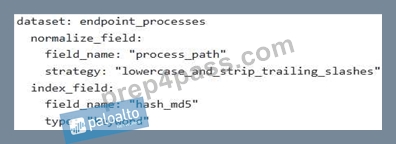
An XSIAM engineer is tasked with optimizing a large volume of endpoint telemetry data, specifically 'Process Creation' events. The raw logs contain highly granular details, including 'process _ path', 'command_line', 'parent_process_id', 'user_sid', and 'hash_md5'. To improve query performance for common threat hunting queries (e.g., 'find all processes launched from a specific path' or 'identify processes with suspicious command-line arguments'), the engineer decides to normalize and enrich the dat a. Which XSIAM content optimization rule (represented conceptually) would best facilitate efficient querying for the 'process_path' and 'hash_md5' attributes?
- A.
- B.

- C.

- D.

- E.

Answer: A
Explanation:
To improve query performance for common threat hunting queries on 'process_path' and 'hash_md5', normalization and proper indexing are key. Option B suggests normalizing 'process_path' (e.g., consistent casing, removing redundant characters) which aids in exact matching and range queries, and crucially, it explicitly states 'index_field' for 'hash_md5' as a 'keyword'. Indexing 'hash_md5' as a keyword type is highly efficient for exact lookups, which is typical for hash matching in security investigations. Option A is about extraction and enrichment but doesn't directly address query performance for existing fields. Option C is about joining and aggregation. Option D is about filtering and mapping. Option E is about aliasing and tagging, which are useful but don't directly tackle the underlying data structure for query optimization as effectively as normalization and indexing.
NEW QUESTION # 94
An XSIAM engineer is tasked with creating a custom automation workflow that, upon detection of a critical ransomware alert, automatically isolates the affected endpoint and creates a Jira ticket. Which sequence of XSIAM automation components is most appropriate to build this workflow, and what challenge might arise in the Jira integration?
- A. Dashboard Widget Scheduled Report Playbook (with email notification) External Script (for isolation and Jira)
- B. Alert Rule -> Automation Rule -> Playbook (with Cortex XDR action) -> Custom Integration (for Jira)
- C. Log Ingestion Correlation Rule Automation Rule Playbook (with Cortex XDR action and Jira action)
- D. Detection Rule -> Playbook (with Custom Integration for both isolation and Jira)
- E. Incident Layout -> Manual Action Button Playbook (with Jira action) -> Built-in Cortex XDR action
Answer: C
Explanation:
The most appropriate sequence for a fully automated response to a critical alert is: Log Ingestion (feeding data for detection) -> Correlation Rule (to identify the ransomware based on logs) -> Automation Rule (triggered by the correlation, initiating the playbook) -> Playbook (orchestrating the Cortex XDR isolation action and the Jira ticket creation). A common challenge with Jira integration, especially when dealing with structured security data, is correctly mapping the dynamic fields from XSIAM incidents (e.g., incident ID, affected host, alert details) to the potentially custom fields defined in Jira projects. This requires careful configuration of the Jira integration's mapper within the XSIAM content pack or playbook action parameters.
NEW QUESTION # 95
During a routine audit of XSIAM's alert management, a new custom detection rule, 'Suspicious Process Creation by Admin', has been observed generating excessive alerts from a specific server used for automated patch deployment. This server's legitimate activities involve frequent process creations by an administrative account. The XSIAM team wants to reduce this noise without entirely disabling the valuable rule. Which two (2) configurations are valid and effective methods to address this within XSIAM's exception and exclusion capabilities?
- A. Integrate with a CMDB to dynamically tag as a 'Known_Baseline' host, and then configure the rule to ignore 'Known_BaseIine' hosts.
- B. Implement a 'Global Exception' for all events originating from 'host.hostname =
- C. Modify the rule to lower its threshold for the specific server's process creation events.
- D. Set up an 'Alert Suppression Rule' in 'Alert Management' that matches 'alert_name = AND 'host.hostname = , with an action to 'Do Not Create Alert'.
- E. Create a new 'Exclusion' for the 'Suspicious_Process_Creation_by_Admirf rule, filtering events where 'host.hostname = AND process.parent.name = 'patch_deployer.exe' .
Answer: D,E
Explanation:
Both B and C are valid and effective. Option B, creating an 'Exclusion' directly within the rule, prevents the alert from being generated at the source based on specific event criteria, which is a very clean approach for known false positives. Option C, an 'Alert Suppression Rule' with 'Do Not Create Alert' action, achieves a similar outcome by intercepting the alert before it's officially created in XSIAM. Both prevent alert generation. Option A is not a standard XSIAM feature for rule tuning based on host. Option D is too broad and creates a significant security blind spot. Option E is a good long-term strategy for managing baselines but isn't a direct exception/exclusion configuration for immediate noise reduction; it requires additional integration and rule modification.
NEW QUESTION # 96
You are designing an automation workflow in XSIAM for a global enterprise that requires automated response to critical firewall alerts (e.g., brute-force attempts, highly suspicious outbound connections). The response should involve dynamically updating firewall rules (e.g., blocking source IP) on Palo Alto Networks Next-Generation Firewalls, which are managed by Panoram a. The challenge is ensuring that rule updates are applied to the correct firewall device group and virtual system (vsys) within Panorama, are temporary, and can be reviewed and rolled back if necessary. Which XSIAM playbook structure and Panorama integration approach are most effective and secure, given these constraints, and what are the associated risks?
- A. XSIAM Playbook triggers on firewall alerts. The playbook contains a 'Code' task (Python script) that uses the Palo Alto Networks span-os-python' library to connect to Panorama. The script dynamically identifies the correct device group/vsys, creates a new security rule with a specific tag and timeout, commits the changes, and pushes to relevant firewalls. A subsequent playbook (or manual process) monitors for expiration and removes the rule. Risk: Requires careful handling of Panorama API keys/credentials within XSIAM. Script complexity can be high for dynamic rule creation and rollback, potential for misconfiguration impacting network traffic if not thoroughly tested. Improper error handling can leave firewalls in an inconsistent state.
- B. XSIAM Playbook sends email notifications to the firewall administrator, who then manually applies the rule changes in Panorama. Risk: High latency, human error, not automated.
- C. Firewall alerts are sent to an intermediate SOAR platform. The SOAR platform integrates with Panorama to apply the rule changes. XSIAM receives updates from the SOAR. Risk: Adds an unnecessary layer of complexity and cost; latency due to external platform.
- D. XSIAM integrates with an internal network access control (NAC) solution. The NAC, upon receiving an alert from XSIAM, applies the block on the firewall. Risk: Requires a separate NAC solution to be integrated, potential for misaligned policies if not synchronized with firewall rules.
- E. XSIAM Playbook triggers on firewall alerts. The playbook uses a generic 'Call API' task to directly access the firewall's management API. Risk: Bypasses Panorama for management, making rule consistency and rollback challenging. Direct firewall access can be insecure if not properly segmented.
Answer: A
Explanation:
For dynamic, temporary rule updates on Palo Alto Networks Next-Generation Firewalls managed by Panorama, the most effective and secure approach is to use an XSIAM Playbook with a 'Code' task (Python script) leveraging the 'pan-os-python' library. This library provides robust and idiomatic Python bindings for interacting with Panorama's XML API or REST API. Effectiveness: The script can dynamically determine the target device group and vsys from the incident context, create precise security rules with time-based expiration (e.g., using 'timeout' or scheduling a cleanup task), and manage rule tags for easy identification and rollback. The span-os-python' library handles the complexities of API interaction, including committing and pushing configurations. Security: All API credentials for Panorama should be securely stored in XSIAM's vault. The script must implement robust error handling (e.g., 'try-except' blocks for API calls, validation of API responses) to prevent misconfigurations or leaving the firewall in an inconsistent state. Risks: 1. Complexity: The Python script can be complex, especially when dealing with dynamic rule placement, managing priorities, and ensuring proper rollback. 2. Misconfiguration: Errors in the script or incorrect dynamic parameter resolution can lead to unintended network disruptions (e.g., blocking legitimate traffic). 3. Credential Management: Secure handling and rotation of Panorama API keys are paramount. 4. Visibility/Auditing: Ensure that changes made via the API are properly logged and auditable within Panorama, and that the XSIAM playbook logs capture the success/failure of the action. Option A bypasses Panorama, defeating centralized management. Options C, D, E are either too complex, lack automation, or divert the core functionality from XSIAM.
NEW QUESTION # 97
As an XSIAM engineer, you are tasked with implementing a highly granular content optimization strategy using scoring rules. The requirement is that alerts from certain detection rules should have their scores influenced by a user's department (e.g., 'Finance', 'Engineering') and, additionally, by the time of day (e.g., 'business_hours', 'non_business_hours'). This means a 'Suspicious Login' from a 'Finance' user during 'non_business_hours' should have the highest score. Which XSIAM capabilities and best practices are crucial for achieving this complex scoring logic effectively and maintainably?
- A. Create user-group-specific detection rules (e.g., 'Suspicious Login - Finance', 'Suspicious Login - Engineering') and manually assign different 'rule_weight' values based on department and time, duplicating detection logic.
- B. Utilize XSIAM's built-in 'Time Zones' and 'Business Hours' configurations and create multiple, chained scoring rules. Each rule focuses on a specific condition (e.g., one for 'Finance' users, another for 'non_business_hours'), with later rules applying additive or multiplicative changes based on combined context.
- C. Define time-based lookup lists (e.g., 'business_hours_ips') and use a single scoring rule with a complex XQL join across alert data, user data, and time data to calculate the final score using a 'case' statement.
- D. Integrate XSIAM with an external SOAR platform that receives all alerts, enriches them with department and time data, and then pushes back a calculated severity score to XSIAM.
- E. Develop a custom Python script that periodically fetches all 'Suspicious Login' alerts via the XSIAM API, performs external calculations based on department and time, and then uses the API to update each alert's score.
Answer: B
Explanation:
Option B is the most effective and native XSIAM approach for achieving complex, multi-factor scoring. Chain Multiple Scoring Rules: XSIAM's scoring rules allow for sequential evaluation based on 'Order'. You can create an initial rule that applies a base score change based on 'department' (e.g., boosting Finance). Then, subsequent rules can apply further additive/multiplicative changes if the 'time of day' condition is met (e.g., boosting 'non_business_hours' for a suspicious event). This 'chaining' allows for granular control. Built-in Time Zone/Business Hours: XSIAM provides capabilities to define business hours and time zones, which can be referenced directly in scoring rule conditions (e.g., 'alert.timestamp is_in_business_hours()'). This simplifies the time-based logic. Maintainability: This approach separates concerns (department logic vs. time logic) into manageable scoring rules, making it easier to debug and update compared to monolithic logic. Option A: While XQL is powerful, constructing a single, overly complex scoring rule with joins and nested 'case' statements for dynamic score calculation is generally not the recommended way to configure scoring rules in XSIAM's UI, which favors a modular approach. Such complex XQL is better suited for detection rules or insights, not direct score 'actions'. Option C: Duplicating detection logic ('rule_weight') is bad practice. It leads to maintenance overhead and doesn't leverage the power of post-detection scoring for dynamic adjustments. Option D: This is an external automation, not a native content optimization strategy within XSIAM's scoring engine. It adds complexity, latency, and an external dependency. Option E: Similar to D, while SOAR can enrich and manage incidents, relying solely on it for fundamental scoring within XSIAM is not leveraging XSIAM's native capabilities effectively and adds unnecessary architectural complexity for what XSIAM can do inherently.
NEW QUESTION # 98
A security engineer is optimizing Broker VM deployment for performance and resilience. The current setup involves a single Broker VM handling a high volume of logs from various sources. To improve fault tolerance and scalability, the engineer plans to deploy an additional Broker VM and distribute log sources between them. What considerations are critical to ensure that log data is not duplicated or lost during this transition, and how can the load be effectively balanced without requiring extensive re-configuration of all log sources?
- A. Manually re-point half of the log sources to the new Broker VM's IP address, ensuring a phased migration to avoid data loss.
- B. Utilize DNS Round Robin for the Broker VM hostname, and update all log sources to resolve to the new DNS entry, ensuring even distribution.
- C. Deploy a dedicated log forwarding tool (e.g., rsyslog, NXLog) on a central server to ingest all logs, and then forward them to the Broker VMS based on load.
- D. Implement a network load balancer (e.g., F5, NetScaler) in front of both Broker VMs, configuring log sources to send data to the load balancer's VIP.
- E. Configure both Broker VMS in an Active-Passive cluster using their built-in clustering features to provide failover.
Answer: D
Explanation:
To achieve load balancing and fault tolerance without extensive re-configuration of all log sources, a network load balancer (A) is the most effective solution. Log sources send data to a single Virtual IP (VIP) of the load balancer, which then distributes the traffic to the healthy Broker VMs. If one Broker VM fails, the load balancer automatically directs traffic to the remaining healthy ones, ensuring continuity and preventing data loss. Option B is manual and prone to errors. Option C is incorrect; Broker VMS don't have built-in active-passive clustering for log ingestion in the way traditional HA pairs do. Option D (DNS Round Robin) is a simple load balancing method but lacks health checks, meaning it could still send traffic to a failed Broker VM. Option E introduces another layer of complexity and a new single point of failure if that forwarding tool goes down.
NEW QUESTION # 99
A threat actor has successfully executed a supply chain attack against a third-party software vendor, leading to malicious updates being pushed to several of your organization's endpoints. Your XSIAM deployment detected the malicious executable by its hash and created incidents. An XSIAM engineer needs to implement an automated workflow to rapidly contain the threat and gather forensics. This involves:
1. Isolating affected endpoints via Cortex XDR.
2. Creating a snapshot of the compromised endpoint's memory and disk for forensic analysis.
3. Uploading the memory dump and suspicious files to a secure, external S3 bucket.
4. Notifying the incident response team via Microsoft Teams with a summary and S3 link.
Given that the memory and disk snapshotting tools are custom internal scripts, and the S3 upload requires specific API calls, how would the engineer design the XSIAM content pack and playbooks to achieve this, considering secure execution, large data transfer, and asynchronous operations?
- A. Content Pack: Integrations for Cortex XDR, MS Teams.
- B. Content Pack: Integrations for Cortex XDR, MS Teams, and a custom 'Forensics Agent' integration.
- C. Content Pack: Integrations for Cortex XDR, S3, MS Teams.
- D. Content Pack: Integrations for Cortex XDR, MS Teams, and a Custom API Gateway Integration.
- E. Content Pack: Integrations for Cortex XDR, S3, and MS Teams.
Answer: B
Explanation:
This scenario involves custom tools (snapshotting) and large data transfer (memory dumps, suspicious files) securely to S3, along with asynchronous operations. The best approach leveraging XSIAM's strengths for such complex custom actions is to develop a dedicated custom integration that conceptually acts as a 'Forensics Agent'. Option C proposes: Content Pack with Custom 'Forensics Agent' integration: This is the ideal solution. Instead of executing local scripts on the XSIAM engine (which is risky and not designed for large data transfer as in option A) or building an entire API Gateway (option B), you define a custom integration within XSIAM (e.g., called 'ForensicsAgent'). Agent Deployment: This 'integration' implies that there's a lightweight agent or service deployed in the environment (perhaps on a dedicated forensics server, or even on the endpoints themselves, depending on the architecture). This agent exposes an API that XSIAM's custom integration can call. Handling Complexity: The agent itself handles the execution of the custom snapshotting scripts locally, manages the large data transfer (e.g., chunking, retransmission, secure transport) directly to S3 (or to an intermediate staging server), and then reports back the S3 link or status to XSIAM. Playbook Flow: The XSIAM playbook simply calls a command like '!ForensicsAgent-snapshotAndlJpload endpoint_id=${incident.endpoint_id}'. The playbook receives the S3 link as an output and uses it for the Teams notification. This centralizes the complex custom logic within the agent and its integration, making the XSIAM playbook clean, secure, and efficient for orchestration. The challenge is indeed developing and deploying this custom agent infrastructure, but it's the most robust solution for this specific set of requirements. Option A is problematic for security and scale. Option B is plausible but often overkill unless there are many such custom integrations. Option D is manual. Option E introduces unnecessary complexity by externalizing to another SOAR platform when XSIAM can manage custom integrations directly.
NEW QUESTION # 100
A global SOC team uses XSIAM and operates 24/7. They have distinct geographical teams (e.g., APAC, EMEA, AMER) that are responsible for incidents occurring in their respective regions. They want to ensure that analysts primarily see and manage incidents relevant to their region. While full isolation isn't required (managers need a global view), data partitioning for regional analysts is crucial. How can XSIAM's access control features be configured to support this requirement while maintaining a unified platform?
- A. Create separate XSIAM instances for each region to achieve complete data and access isolation.
- B. Develop custom XSIAM playbooks that automatically reassign incidents to the correct regional analyst queue based on incident source IP geolocation.
- C. Utilize XSIAM's built-in Multi-Tenancy feature, assigning each region to a dedicated tenant.
- D. Implement data tagging based on region during data ingestion, and then create custom roles with XQL query filters that limit incident visibility to incidents with the corresponding regional tag for each analyst team.
- E. Configure XSIAM with geographical IP address restrictions, allowing regional analysts to only access XSIAM from their respective regions.
Answer: D
Explanation:
For data partitioning within a unified platform, XSIAM's capability to filter data based on attributes (like regional tags) through XQL queries within custom roles is the most effective and elegant solution. This allows all data to reside in a single instance but presents a filtered view based on the user's role. Option A and B (separate instances/tenants) are for complete isolation, which isn't required here and adds management overhead. Option D is about network access, not data segmentation within XSIAM. Option E is about workflow automation for assignment, not primary data visibility control.
NEW QUESTION # 101
A financial institution requires a custom XSIAM integration to automate user account disablement in their Active Directory (AD) whenever a specific type of malicious activity is detected. The integration needs to use a privileged service account for AD operations, and the credentials must be stored securely and rotated automatically. How would an XSIAM engineer design this, ensuring security best practices?
- A. Define the AD service account as an 'XSIAM User' with specific roles and use its API key directly in the playbook for AD operations.
- B. Employ a 'Command' integration to execute a local script on the XSIAM engine, storing credentials in a local file encrypted with an insecure key.
- C. Use a 'Generic API' integration pointing to a custom API Gateway that handles AD operations and secret management externally.
- D. Develop a custom 'PowerShell' or 'Python' integration within a Content Pack, configure the service account credentials as 'Integration Parameters' using a 'Secure Credentials' field type, and leverage XSIAM's built-in credential rotation where available.
- E. Create a custom 'HTTP' integration, hardcode the service account credentials in the playbook Python script, and leverage an external secrets management tool.
Answer: D
Explanation:
For secure and automated credential management within XSIAM custom integrations, the best approach is to define the service account credentials as 'Integration Parameters' with a 'Secure Credentials' field type when developing the custom PowerShell or Python integration within a Content Pack. XSIAM provides mechanisms to securely store these credentials and, for supported types, can manage their rotation. This ensures the credentials are encrypted at rest and in transit, not exposed in plain text in playbooks, and adhere to security best practices. Option A is insecure due to hardcoding. Option C offloads security to an external gateway, which is possible but less integrated. Option D is highly insecure. Option E incorrectly assumes XSIAM user API keys can be used for external system operations, which is not their purpose.
NEW QUESTION # 102
A new XSIAM indicator rule aims to detect file exfiltration attempts by monitoring large file transfers to external, unsanctioned cloud storage services. The rule is currentl defined as:
This rule is generating too many false positives because legitimate business operations involve transferring large files to some of these cloud services (e.g., for partners, or sanctioned instances). To effectively optimize this rule, which combination of XSIAM features and XQL modifications should be considered?
- A. Integrate an internal lookup list (context table) of 'Sanctioned Cloud Storage URLs/lPs' that are allowed, and modify the XQL to exclude events where remote_ip_addresS or 'url_hostname' match entries in this lookup list. Additionally, correlate with 'user_name' and 'application_name' for further context.
- B. Change the rule type to 'Behavioral' to leverage XSIAM's built-in exfiltration models, and disable this indicator rule.
- C. Add a join with 'network_connection' dataset and filter for 'application_name' being 'web-browsing' or 'ftp', then add an exclusion for 'user_name' in a 'sanctioned users' list.
- D. Enable XSIAM's 'User Behavioral Analytics (UBA)' and rely solely on UBA for exfiltration detection, as it will learn baselines for legitimate user activity.
- E. Modify the list to exclude sanctioned IPs, and increase the 'file_size' threshold to 500MB.
Answer: A
Explanation:
Option C is the most comprehensive and effective approach for content optimization in this scenario. Internal Lookup List: Creating a context table (lookup list) of sanctioned cloud storage URLs/lPs is crucial for managing allowed destinations dynamically. The rule can then explicitly exclude traffic to these known good destinations. Exclude by IP/URL: Using 'not in' or 'not (remote_ip_address in sanctioned_ips or url_hostname in sanctioned_urls)' in the XQL query directly addresses the false positive issue from legitimate usage of specific cloud services. Correlate with User and Application: Adding 'user_name' and 'application_name' context allows for more granular tuning. For example, you might permit certain users or applications to transfer large files to specific sanctioned cloud services, further reducing false positives. This makes the rule adaptable to specific business processes. Option A is a partial solution; increasing file size alone might miss smaller but malicious exfiltrations, and manually maintaining exclusions in the Tl list is not scalable. Option B is too generic for network connections and might not be sufficient. Option D and E are valid, but they represent a shift away from a specific indicator rule to broader behavioral analytics. While UBA and behavioral rules are powerful, they might not catch highly specific IOCs immediately, and the question asks for optimizing the indicator rule.
NEW QUESTION # 103
A new XSIAM marketplace content pack introduces a 'phishing_analysis' incident type with a specific 'Phishing Incident Response' playbook. After installation, the security team notices that incoming email alerts, even clearly identified as phishing, are still being classified as generic 'email' incidents and not triggering the new playbook. What is the most likely reason for this, and what action is required?
- A. The new content pack is incompatible with the existing email integration and requires a custom script to bridge the gap.
- B. The incident 'Mapper' for the email integration is not updated to map incoming email fields to the new 'phishing_analysis' incident type's fields.
- C. The incident 'Classifier' for the email integration is not updated or configured to recognize phishing indicators and assign the 'phishing_analysis' incident type.
- D. The 'Phishing Incident Response' playbook is not enabled. It needs to be manually toggled on in the Playbook settings.
- E. XSIAM's machine learning model for incident classification needs to be retrained with new phishing email samples.
Answer: C
Explanation:
For incoming data to be classified as a specific incident type and trigger a corresponding playbook, the 'Classifier' for the data source (in this case, the email integration) must be configured to identify the characteristics of the new incident type ('phishing_analysis'). The content pack provides the new incident type and playbook, but the existing data ingestion mechanisms need to be told how to recognize and assign that type. Option A is a possibility but less specific to classification issues. Option B deals with mapping fields AFTER classification. Options D and E are less likely primary reasons.
NEW QUESTION # 104
......
XSIAM-Engineer Dumps To Pass Palo Alto Networks Exam in 24 Hours - Prep4pass: https://www.prep4pass.com/XSIAM-Engineer_exam-braindumps.html
Palo Alto Networks XSIAM-Engineer Actual Questions and Braindumps: https://drive.google.com/open?id=1cPg-lqEF2N7k39zHjgb_zPcAMka3_ldM
