

2024 Updates For the Latest Data-Integration-Developer Free Exam Study Guide!
Best Data-Integration-Developer Exam Preparation Material with New Dumps Questions
NEW QUESTION # 13
You have two Talend Jobs. Job A need to call Job B. After Job B is complete, processed data stored in the tBufferOutput buffer memory must be transferred back to Job A.
How can you achieve this requirement?
- A. Select the Transmit whole context in the basic settings of the tRunJob when calling Job B from Job A.
- B. Select the Propagate the child result to output schema in Advanced settings of the tRunJob when calling Job B from Job B.
- C. Select the Propagate the child result to output schema in the Basicsettings of the tRunJob when calling B from Job A.
- D. Select the Transmit whole context in Advanced settings of the tRunJob when calling Job B from Job A.
Answer: B
Explanation:
Explanation
To call a different job within a job you are developing, you can use the tRunJob component. This component allows you to execute another job as a subjob within a parent job. To pass the parameters to the job you want to call, you can use the context parameters. Context parameters are variables that can store values that can be changed at runtime or between different contexts. You can define context parameters in the Contexts tab of your job and assign them values for each context. You can also pass context parameters from the parent job to the child job by using the Context Param tab of the tRunJob component. This way, you can parameterize the properties or expressions of the child job with the values from the parent job.
To transfer processed data stored in the tBufferOutput buffer memory back to the parent job, you need to select the Propagate the child result to output schema option in the Advanced settings of the tRunJob component. This option allows you to retrieve the data from the tBufferOutput component of the child job and send it to an output row of the parent job. The tBufferOutput component is used to store data in memory without writing it to disk or database. You can use this component to optimize the performance and memory usage of your job.
You do not need to select the Transmit whole context option in either Basic or Advanced settings of the tRunJob component. This option allows you to pass all the context parameters from the parent job to the child job without specifying them individually. This option does not affect the data transfer from the tBufferOutput component. You also do not need to select the Propagate the child result to output schema option in Basic settings of the tRunJob component, as this option is only available in Advanced settings. References: Talend Open Studio: Open-source ETL and Free Data Integration | Talend, [tRunJob properties - 7.3], [tBufferOutput properties - 7.3], [Contexts - 7.3]
NEW QUESTION # 14
Using the following input file format as an example: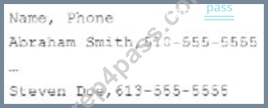
Which tFileinputDelimted component parameters should you configure to parse the input file correctly?
Choose 3 answers
- A. Footer
- B. Limit
- C. Field separator
- D. Header
- E. Schema
Answer: C,D,E
Explanation:
Explanation
Using the following input file format as an example: <OCR>Name, Phone Abraham Smith, 510-555-5555 ... Steven Doe, 613-555-5555 </OCR> The tFileInputDelimited component parameters that you should configure to parse the input file correctly are Schema, Field separator, and Header. The Schema parameter defines the structure and type of the data in the input file. You can use a built-in schema or a repository schema to specify the columns and their properties.
The Field separator parameter defines the character that separates each field in a row of data. In this case, it is a comma (,). The Header parameter defines the number of rows to be skipped at the beginning of the file. In this case, it is 1, as the first row contains the column names.
NEW QUESTION # 15
Which parameters are defined in File Delimited metadata?
Choose? answers
- A. Position of the fields
- B. File Path
- C. ROW Separator
- D. Component with which the metadata is associated
Answer: B,C
Explanation:
Explanation
The parameters that are defined in File Delimited metadata are:
Row separator: This parameter defines the character or string that separates each row of data in a delimited file. For example, a row separator can be a newline character (\n), a carriage return (\r), or a combination of both (\r\n).
File path: This parameter defines the location and name of the delimited file that you want to read or write. You can browse your local system or enter a URL to specify the file path. You can also use context variables or global variables to make the file path dynamic.
NEW QUESTION # 16
Where can you simultaneously define primary keys for the Update and Delete operations in a tMysqlOutput component?
- A. Advanced settings view, select the Additional columns options check box
- B. Advanced settings view, select the Use hint options check box
- C. Basic settings view, select the Use field options check box
- D. Advanced settings view, select the Use field options check box
Answer: D
Explanation:
Explanation
The tMysqlOutput component is used to write data into a MySQL database table. The Update and Delete operations are used to modify or remove existing rows in the table based on a primary key. To define the primary key for these operations, you need to use the Use field options check box in the Advanced settings view of the component. This will enable you to specify which columns are used as keys for each operation.
You can also define other options for each column, such as nullable, length, precision, etc. The Use field options check box is not available in the Basic settings view of the component. The Additional columns options check box and the Use hint options check box are used for other purposes, such as adding extra columns or hints to the SQL query, and they do not affect the primary key definition. References: Talend Open Studio: Open-source ETL and Free Data Integration | Talend, [tMysqlOutput properties - 7.3]
NEW QUESTION # 17
Which characteristics distinguish Traces Debug from Java Debug?
Choose 2 answers
- A. Supports breakpoints based on input data condition
- B. Allow row-by-row inspection of data flows
- C. Requires a separate perspective
- D. Require Java development experiences
Answer: A,B
Explanation:
Explanation
Trace Debug and Java Debug are two modes that allow you to debug your jobs in Talend Studio. Trace Debug mode allows you to trace each row processed by your job components and see the values of each column in each row. Java Debug mode allows you to debug your job code in Java or Perl and see the values of each variable or expression in your code.
The characteristics that distinguish Trace Debug from Java Debug are:
Trace Debug mode allows row-by-row inspection of data flows, while Java Debug mode does not. Data flows are the links that show the data transfer between components in your job design workspace. In Trace Debug mode, you can see the data flow on each trace and inspect the values of each column for each row processed by your job. You can also use filters to display only the rows that match a condition or an expression. In Java Debug mode, you cannot see the data flow on each trace or inspect the values of each column for each row.
Trace Debug mode supports breakpoints based on input data condition, while Java Debug mode does not. Breakpoints are points where the execution of your job pauses and waits for your action. You can use breakpoints to inspect your data or debug your logic at specific points of your job execution. In Trace Debug mode, you can set breakpoints on traces based on a condition or an expression that involves input data columns. For example, you can set a breakpoint to pause your job when a customer name contains a certain string or when a product price exceeds a certain value. In Java Debug mode, you can only set breakpoints on lines of code based on a condition or an expression that involves variables or expressions.
The characteristics that do not distinguish Trace Debug from Java Debug are:
Both modes require a separate perspective. A perspective is a set of views and editors that are arranged in a specific way to support a specific task. In Talend Studio, you can switch between different perspectives, such as Integration, Debug, Profiling, etc. To use Trace Debug mode, you need to switch to the Debug perspective by clicking on the Open Perspective button and selecting Debug. To use Java Debug mode, you need to switch to the Java perspective by clicking on the Open Perspective button and selecting Java.
Neither mode requires Java development experience. Although Java Debug mode allows you to debug your job code in Java or Perl, you do not need to have Java development experience to use it. You can use the graphical interface of Talend Studio to design your job components and properties without writing any code. You can also use the Code view to see the generated code of your job in Java or Perl and modify it if needed. However, you do not need to write any code from scratch or understand all the details of the code to use Java Debug mode. References: Talend Open Studio: Open-source ETL and Free Data Integration | Talend, [Trace Debug mode - 7.3], [Java Debug mode - 7.3]
NEW QUESTION # 18
How do you create an empty Joblet?
- A. Right-clicking a space in the Designer and select refactor to Joblect.
- B. Right-click Joblet Designs the Repository and select Create Joblet.
- C. Create an empty Jon and use the file menu to save it as Joblet.
- D. Create an empty Job, then export it as a Joblet by right-clicking it in the Repository.
Answer: B
Explanation:
Explanation
To create an empty Joblet, you need to right-click on the Joblet Designs node in the Repository tree view and select Create Joblet option. This will open a dialog box whereyou can enter the name and description of your Joblet and select an icon for it. You can then design your Joblet by adding components and links to it in the Designer workspace.
You cannot create an empty Joblet by creating an empty job, then exporting it as a Joblet by right-clicking it in the Repository, creating an empty job and using the file menu to save it as Joblet, or right-clicking a space in the Designer and selecting refactor to Joblet. These methods are not available in Talend Studio and may cause errors or unexpected results. References: Talend Open Studio: Open-source ETL and Free Data Integration | Talend, [Joblets - 7.3]
NEW QUESTION # 19
In Talend Studio, you have access to a references project named project_ref. You need to reuse a Job named testJob from the project_ref in your main Job.
- A. Navigate to @ Referenced project, @ project_ref, Job Designs, Standard, then select testJob.
- B. Right-click Job Designs and click import items.
- C. Right-click Job Designs, click Crete Standard Job, and enter testJob as the Job name.
- D. Navigate to Metadata, @ project ref, Job Designs, Standard, then select testJob.
Answer: A
Explanation:
Explanation
To reuse a job named testJob from a referenced project named project_ref in your main job, you need to navigate to @Referenced project, @project_ref, Job Designs, Standard, then select testJob. A referenced project is a project that can be accessed from another project in read-only mode. You can add a referenced project to your main project by using the Project Settings window in Talend Studio. You can then browse the items (such as jobs, metadata, routines, etc.) of the referenced project in the Repository tree view under the
@Referenced project node. You can drag and drop any item from the referenced project to your main job design workspace.
You do not need to use import items, create standard job, or navigate to Metadata options. These options are not used to reuse jobs from referenced projects. The import items option is used to import items (such as jobs, metadata, routines, etc.) from an archive file that can be exported from another project or workspace. The create standard job option is used to create a new job with a name and a description. The Metadata node in the Repository tree view is used to store and manage metadata definitions for various data sources (such as databases, files, web services, etc.). References: Talend Open Studio: Open-source ETL and Free Data Integration | Talend, [Referenced projects - 7.3]
NEW QUESTION # 20
You are using the tMap component to configure a mapping.
What do the tables on the left side of the Map Editor window represent?
- A. Explosions to apply to the input data
- B. Expression to apply to the output data
- C. Schemas of the output rows
- D. Schemas of the input rows
Answer: D
Explanation:
Explanation
The tables on the left side of the Map Editor window represent the schemas of the input rows. The schemas define the structure and type of the data that is coming from the input components connected to the tMap component. You can drag and drop columns from the input tables to the output tables on the right side of the Map Editor window to create mappings and transformations.
NEW QUESTION # 21
Which statements ate true about a tWarn component?
Choose 2 answers
- A. Used to trigger a warning often caught by the tLogCatcher component for an exhaustive log.
- B. Used alongside a tLogCatcher in order for the log data collected to be encapsulated and passed on to the output defined.
- C. Used only in conjunction with a iLogCatcher component.
- D. Used only in conjunction with the log4j feature.
Answer: A,B
Explanation:
Explanation
The tWarn component is used to trigger a warning message that can be caught by the tLogCatcher component for an exhaustive log. The tLogCatcher component is a component that collects the log data generated by the tWarn, tDie, and Java Exception components and passes it on to the output defined. The tWarn component can be used alongside a tLogCatcher component in order for the log data collected to be encapsulated and passed on to the output defined. The tWarn component can also be used independently of the tLogCatcher component, but in that case, the warning message will only be displayed in the console. The tWarn component is not used only in conjunction with the log4j feature, nor only in conjunction with a tLogCatcher component.
The log4j feature is a logging framework that allows you to customize the logging level, format, and destination of your log messages. You can enable or disable the log4j feature in Talend Studio by checking or unchecking the Use log4j option in the Preferences menu. The tLogCatcher component can catch log data from other components besides the tWarn component, such as the tDie and Java Exception components. References: Talend Open Studio: Open-source ETL and Free Data Integration | Talend,
NEW QUESTION # 22
You are building a Job that consists of two subJobs being sequentially executedI he first subJob completes successfully.
Which component in the first subJob triggers the execution of the second subJob?
- A. Any component
- B. Input component
- C. Start component
- D. Final component
Answer: C
Explanation:
Explanation
The Start component in a subjob triggers the execution of the next subjob in a sequential order. The Start component is used to define where a subjob begins and to link it with other subjobs within a job. The Start component has only one output link that can be connected to any other component in the same subjob or to another Start component in another subjob. When a subjob completes successfully, it sends an OnSubjobOk trigger to its Start component, which then activates the next subjob linked to it. The Final component, on the other hand, is used to define where a subjob ends and to perform some actions after its completion, such as sending anemail or logging a message. The Final component has no output link and does not trigger any other subjob. The Input component and any other component in a subjob do not trigger any other subjob by themselves, unless they are connected to a Start component through an output link or an OnComponentOk trigger. References: Talend Open Studio: Open-source ETL and Free Data Integration | Talend, [Start properties - 7.3], [Final properties - 7.3]
NEW QUESTION # 23
You need to set up a server in your Talend environment that enables several members of your team to collaborate on a project.
Which application must you enable before working on a remote project?
- A. Talent Administration Center instance must be running with the team members and project configured.
- B. Git or SVN server instance must be running.
- C. Git or SVN client must be installed on each developed workstation.
- D. Talend admission Center service must be running on each development workstation.
Answer: A,B
Explanation:
Explanation
To set up a server in your Talend environment that enables several members of your team to collaborate on a project, you need to enable two applications before working on a remote project: Git or SVN server instance and Talend Administration Center instance. These applications are used to manage version control and collaboration for your project.
Git or SVN server instance is a server application that allows you to store and track changes of your project files using a version control system. Git and SVN are two popular version control systems that are supported by Talend Studio. You need to have a Git or SVN server instance running and accessible by your team members before working on a remote project. You also need to have a Git or SVN client installed on each development workstation to connect to the server and perform version control operations.
Talend Administration Center is a web-based application that allows you to manage users, projects, tasks, execution servers, and licenses for your Talend environment. You need to have a Talend Administration Center instance running and accessible by your team members before working on a remote project. You also need to configure the team members and project settings in Talend Administration Center to grant access and permissions for your project. References: Talend Open Studio: Open-source ETL and Free Data Integration | Talend, [Version control - 7.3], [Talend Administration Center - 7.3]
NEW QUESTION # 24
Which factors can affect the context in which a Job is run?
Choose 2 answers
- A. Context chosen by the developer when running the Job. Context available in the Basic Run tab of Run Job section.
- B. tContextDump component ran change the context name in the course of the lob execution.
- C. tRunJob component can influence the context in which the child Job runs.
- D. tContextLoad component can change the context name in the course of the Job execution.
Answer: A,C
Explanation:
Explanation
The context in which a job is run can be affected by different factors, such as the context chosen by the developer when running the job, or the tRunJob component that can influence the context in which the child job runs. The context chosen by the developer when running the job can be selected from the Basic Run tab of Run Job section in Talend Studio. This allows the developer to test the job with different sets of context variables without modifying the job design. The tRunJob component can be used to call another job as a subjob within a parent job. The tRunJob component can pass the context parameters from the parent job to the child job, or use a specific context for the child job. This allows the developer to reuse existing jobs and control their execution contexts. The tContextLoad component and the tContextDump component do not affect the context name in which a job is run, but they can affect the context values. The tContextLoad component can load context parameters from a file or a database table at runtime and overwrite the existing values. The tContextDump component can display or save the current context parameters and their values for debugging purposes. References: Talend Data Integration - Software to Connect, Access, and Transform Data | Talend, [tRunJob properties - 7.3], [tContextLoad properties - 7.3], [tContextDump properties - 7.3]
NEW QUESTION # 25
What is the generic Input component used for in a Joblet design?
- A. Carrying data into a Joblet
- B. Carrying data into a subJob
- C. Triggering a Joblet
- D. Triggering a subJob
Answer: A
Explanation:
Explanation
The generic Input component used for in a Joblet design is the tJobletInput component. This component is used to carry data into a Joblet from another component in the job that contains the Joblet. A Joblet is a reusable piece of a job that can be used in multiple jobs as a single component. A Joblet can have one or more input and output flows that connect it with other components in a job. To create these flows, you need to use generic input and output components, such as tJobletInput, tJobletOutput, tJobletTriggerInput, and tJobletTriggerOutput. These components allow you to define schemas and triggers for your Joblet without depending on specific components.
The tJobletInput component is not used for triggering a Joblet, triggering a subjob, or carrying data into a subjob. These are different concepts and functionalities in Talend Studio. A trigger is a link that activates a subjob or a component based on a condition or an event. A subjob is a part of a job that consists of one or more components connected by data flows or triggers. A subjob can be triggered by another subjob using triggers such as OnSubjobOk, OnSubjobError, Run if, etc. A subjob can also carry data into another subjob using data flows such as main, lookup, reject, etc. References: Talend Open Studio: Open-source ETL and Free Data Integration | Talend, [tJobletInput properties - 7.3], [Joblets - 7.3], [Triggers - 7.3]
NEW QUESTION # 26
A colleague has exported a Data Integration Job to run outside Talend Studio.
How do you run the Job?
- A. Install the Job and start the resulting service.
- B. Extract the contents of the archive and run the batch file and shell script.
- C. Extract the content of the archive and run the batch file or the shell script.
- D. Extract the files from the archive and run the JAR file.
Answer: C
Explanation:
Explanation
To run a job that has been exported by a colleague to run outside Talend Studio, you need to extract the content of the archive and run the batch file or the shell script. The archive file contains all the files and libraries required to run the job independently from Talend Studio on any platform that supports Java. The archive file also contains two executable files: a batch file (.bat) for Windows platforms and a shell script (.sh) for Linux platforms. You need to run the appropriate file for your platform by double-clicking on it or using a command line tool. This will launch the job and display its output in a console window.
You do not need to extract the contents of the archive and run both the batch file and shell script, install the job and start the resulting service, or extract the files from the archive and run the JAR file. These methods are not correct or available in Talend Studio and may cause errors or unexpected results. References: Talend Open Studio: Open-source ETL and Free Data Integration | Talend, [Build Job - 7.3]
NEW QUESTION # 27
What determines the name of the tMap output row that delivers join rejects?
- A. The name is configurable in the Component view of the tMapcomponent
- B. The name is determined by the output table you create to catch the rejects.
- C. The name is determined by the input table, you create to generate the rejects.
- D. The name is predetermined; it is always named Innerjoin Reject.
Answer: B
Explanation:
Explanation
The tMap component allows you to configure different types of joins between the main input and the lookup tables, such as inner join, left outer join, right outer join, etc. An inner join returns only the matching rows from both tables based on a join condition. If a row from the main input does not match any row from the lookup table, it is considered as an inner join reject. You can configure an output to collect these rejects by setting the Catch inner join reject option to true. The name of the output row that delivers the join rejects is determined by the output table you create to catch the rejects. You can name the output table as you wish, such as Rejects, Errors, etc. References: Talend Open Studio: Open-source ETL and Free Data Integration | Talend,
NEW QUESTION # 28
You need to call a different Job within a Job you are developing.
Which mechanism allows you to pass the parameters to the lob you want to call?
- A. Context parameters
- B. Java Function paramters
- C. File
- D. CommandLine options
Answer: A
Explanation:
Explanation
To call a different job within a job you are developing, you can use the tRunJob component. This component allows you to execute another job as a subjob within a parent job. To pass the parameters to the job you want to call, you can use the context parameters. Context parameters are variables that can store values that can be changed at runtime or between different contexts. You can define context parameters in the Contexts tab of your job and assign them values for each context. You can also pass context parameters from the parent job to the child job by using the Context Param tab of the tRunJob component. This way, you can parameterize the properties or expressions of the child job with the values from the parent job.
You do not need to use a file, command line options, or Java function parameters to pass parameters to a different job. These methods are not supported by Talend Studio and may cause errors or unexpected results. References: Talend Open Studio: Open-source ETL and Free Data Integration | Talend, [tRunJob properties - 7.3], [Contexts - 7.3]
NEW QUESTION # 29
Which statements are true about configuring the input sources of a tMap component?
Choose answers
- A. The main input source will always be placed on top by default hut ran be dragged to any position.
- B. Thy main input source is always placed on topand cannot be moved within the tMap component.
- C. You can use the up and down arrows to interchange the order of the Lookup tables.
- D. The order in which the input sources appear on the map does not matter, provided the joins are configured correctly.
Answer: B,C
Explanation:
Explanation
The tMap component allows you to configure multiple input sources for your data transformation and mapping. The main input source is always placed on top of the tMap component and cannot be moved within it. The main input source provides the data flow that drives the processing of the tMap component. The lookup tables are placed below the main input source and can be reordered by using the up and down arrows on the toolbar. The order in which the lookup tables appear on the tMap component does not affect the functionality of the joins, as long as they are configured correctly with the appropriate join conditions and expressions. References: Talend Open Studio: Open-source ETL and Free Data Integration | Talend, [tMap properties - 7.3]
NEW QUESTION # 30
You want to use the value of a context variable you defined to configure a component, but you do not remember the exact name. You decide to use the auto-completion feature in Talend Studio Studio to get assistance.
Which keystrokes can you use to trigger auto-completion?
- A. Ctrl + Alt + Space
- B. Fsc + Space
- C. Ctrl + Space
- D. Alt - Space
Answer: C
Explanation:
Explanation
To trigger auto-completion in Talend Studio, you can use the keystrokes Ctrl + Space. This will display a list of possible suggestions based on what you have typed so far. For example, if you type context. and press Ctrl
+ Space, you will see a list of all the context variables you have defined. You can then select the one you want from the list or continue typing to narrow down the choices. Auto-completion can help you avoid typing errors and save time when configuring components or writing expressions. References: Talend Open Studio:
Open-source ETL and Free Data Integration | Talend
NEW QUESTION # 31
You need to call a different Job within a Job you are developing.
Which mechanism allows you to pass the parameters to the lob you want to call?
- A. Context parameters
- B. Java Function paramters
- C. File
- D. CommandLine options
Answer: A
Explanation:
Explanation
To call a different job within a job you are developing, you can use the tRunJob component. This component allows you to execute another job as a subjob within a parent job. To pass the parameters to the job you want to call, you can use the context parameters. Context parameters are variables that can store values that can be changed at runtime or between different contexts. You can define context parameters in the Contexts tab of your job and assign them values for each context. You can also pass context parameters from the parent job to the child job by using the Context Param tab of the tRunJob component. This way, you can parameterize the properties or expressions of the child job with the values from the parent job.
You do not need to use a file, command line options, or Java function parameters to pass parameters to a different job. These methods are not supported by Talend Studio and may cause errors or unexpected results. References: Talend Open Studio: Open-source ETL and Free Data Integration | Talend, [tRunJob properties - 7.3], [Contexts - 7.3]
NEW QUESTION # 32
You created a Job to process a customer database. Next, you want to debug the Job using Traces Debug and pause the execution when it encounters any records for customers residing in the state of California.
- A. Right-click the trace on the output of the input component and select Show Breakpoint Setup.
- B. Add a breakpoint in the Advanced Settings tab of the Run view.
- C. Open the Debug Run tab of the Run view and click Traces Debug.
- D. Right-click the trace on the output of the input component and select Add Breakpoint.
Answer: A
Explanation:
Explanation
To debug a job using Trace Debug mode and pause the execution when it encounters any records for customers residing in the state of California, you need to right-click on the trace on the output of the input component and select Show Breakpoint Setup option. Trace Debug mode is a feature that allows you to trace each row processed by your job components and see the values of each column in each row. You can access this mode by opening the Debug Run tab of the Run view and clicking on Trace Debug button. A trace is a link that shows the data flow between components in your job design workspace.
The Show Breakpoint Setup option allows you to set a breakpoint on a trace based on a condition or an expression. A breakpoint is a point where the execution of your job pauses and waits for your action. You can use breakpoints to inspect your data or debug your logic at specific points of your job execution. You can access this option by right-clicking on a trace on your job design workspace and selecting Show Breakpoint Setup. This will open a dialog box where you can enter a condition or an expression for your breakpoint.
For example, if you want to pause your job execution when it encounters any records for customers residing in the state of California, you can enter this condition for your breakpoint:
row1.state == "CA"
This will make your job stop at the trace where this condition is met and show you the values of each column for that row.
You do not need to add a breakpoint in Advanced settings tab of Run view, open Debug Run tab of Run view and click Trace Debug button, or right-click on trace on output of input component and select Add Breakpoint option. These options are not used to set breakpoints based on conditions or expressions. The Advanced settings tab of Run view is used to configure advanced settings for your job execution, such as JVM arguments, statistics parameters, implicit context load parameters, etc. The Debug Run tab of Runview is used to access Trace Debug mode, but not to set breakpoints. The Add Breakpoint option is used to add a simple breakpoint on a trace without any condition or expression. References: Talend Open Studio: Open-source ETL and Free Data Integration | Talend, [Trace Debug mode - 7.3], [Breakpoints - 7.3]
NEW QUESTION # 33
In the tMap component, where do you set up a filter on the input fields?
- A. Expression filter in the output table
- B. Match Model parameter field for fine of the inputs
- C. Expression field for a single column of the output
- D. Match Model parameter field for one of the main inputs
Answer: A
Explanation:
Explanation
The tMap component allows you to set up a filter on the input fields by using the Expression filter in the output table. The Expression filter is a field where you can enter a logical expression that evaluates to true or false for each input row. For example, if you want to filter out the rows that have null values in a certain column, you can use row1.column != null as the expression filter for that output. The expression filter applies to all the input fields of the row, not just a single column. You cannot set up a filter on the input fields by using the Match Model parameter field for one of the inputs or outputs, as this field is used to define how to match rows between different inputs or outputs based on a key attribute. References: Talend Open Studio:
Open-source ETL and Free Data Integration | Talend
NEW QUESTION # 34
Which statements are true when comparing a Joblet to a tRunJob component?
Choose 3 answers
- A. The performance of a Joblet if better than running an equivalent Job using a tRunJob component.
- B. A Joblet uses the same context variables of the Job in which it is used, unlinke a tRunJob component.
- C. The nested Job called by a tRunJob component cannot use thesame context variable of the Jobin which it is used.
- D. The performance of tRunJob component is better than running an equivalent Job using a Joblet.
- E. Building a Joblet typically requires the use of generic input, and trigger component.
Answer: B,C,E
Explanation:
Explanation
A Joblet is a reusable piece of a job that can be used in multiple jobs as a single component. A tRunJob component is a component that allows you to call another job as a subjob within a parent job. When comparing a Joblet to a tRunJob component, these statements are true:
A Joblet uses the same context variables of the job in which it is used, unlike a tRunJob component. A context variable is a variable that can store a value that can be changed at runtime or between different contexts. A Joblet inherits the context variables from the job that contains it and does not have its own context variables. A tRunJob component can pass context variables from the parent job to the child job, or use a specific context for the child job.
Building a Joblet typically requires the use of generic input and trigger components. A Joblet can have one or more input and output flows that connect it with other components in a job. To create these flows, you need to use generic input and trigger components, such as tJobletInput, tJobletOutput, tJobletTriggerInput, and tJobletTriggerOutput. These components allow you to define schemas and triggers for your Joblet without depending on specific components.
The nested job called by a tRunJob component cannot use the same context variables of the job in which it is used. A nested job is a job that is called by another job using a tRunJob component. A nested job can have its own context variables or receive context variables from its parent job, but it cannot use thesame context variables as its parent job. This means that if you have two context variables with the same name in both jobs, they will be treated as separate variables and will not share values.
These statements are false when comparing a Joblet to a tRunJob component:
The performance of tRunJob component is better than running an equivalent job using a Joblet. The performance of a Joblet is better than running an equivalent job using a tRunJob component. This is because a Joblet is integrated into the main code of the job and does not require launching another JVM process or loading another metadata object like a tRunJob component does. References: Talend Open Studio: Open-source ETL and Free Data Integration | Talend, [Joblets - 7.3], [tRunJob properties - 7.3],
[Contexts - 7.3]
NEW QUESTION # 35
You need to calculate the total number of rows in an input file using a tMlelnputDelimited component.
Which code should you use in a tJava component to write a nb-line variable?
- A. Int nb_line-(integer)globalMap.put(''tFileInputDelimited_1_NB_LINE'')
- B. Int nb_line=(integer)globalMap.put(''tFileInputDelimited_1_NB_LINE'')
- C. Int nb_line-(String)globalMap.put(''tFileInputDelimited_1_NB_LINE'')
- D. Int nb.line-(integer)globalMap.put(''tFileInputDelimited_1_NB_LINE'')
Answer: D
Explanation:
Explanation
You need to use the following code in a tJava component to write a nb_line variable:
int nb_line = (Integer)globalMap.get("tFileInputDelimited_1_NB_LINE");
This code retrieves the value of the global variable tFileInputDelimited_1_NB_LINE, which stores the number of rows processed by the tFileInputDelimited component, and assigns it to an integer variable named nb_line.
You can then use this variable to print or manipulate the number of rows in your Job. Note that you need to use globalMap.get, not globalMap.put, to access the value of a global variable.
NEW QUESTION # 36
......
Talend Data-Integration-Developer Exam Syllabus Topics:
| Topic | Details |
|---|---|
| Topic 1 |
|
| Topic 2 |
|
| Topic 3 |
|
| Topic 4 |
|
| Topic 5 |
|
| Topic 6 |
|
| Topic 7 |
|
| Topic 8 |
|
Free Data-Integration-Developer Exam Files Verified & Correct Answers Downloaded Instantly: https://www.prep4pass.com/Data-Integration-Developer_exam-braindumps.html
Fast Exam Updates Data-Integration-Developer dumps with PDF Test Engine Practice: https://drive.google.com/open?id=1LSwhrnVIRH2pzIJrU_nr1vCY-KRMuRsM
