

Real Development-Lifecycle-and-Deployment-Architect Exam PDF Test Engine Practice Test Questions
Salesforce Development-Lifecycle-and-Deployment-Architect Real 2024 Braindumps Mock Exam Dumps
Salesforce Development-Lifecycle-and-Deployment-Architect exam is designed for individuals who want to demonstrate their expertise in Salesforce development lifecycle and deployment. It is one of the most prestigious certifications offered by Salesforce and is highly valued by employers in the IT industry. Development-Lifecycle-and-Deployment-Architect exam focuses on testing the candidate's ability to design and manage the development lifecycle of Salesforce applications, as well as their knowledge of deployment strategies and best practices.
NEW QUESTION # 121
Universal Containers is starting a Center of Excellence (COE). Which two user groups should an Architect recommend to join the COE?
- A. Executive Sponsors.
- B. Program Team
- C. Inside Sales Users.
- D. Call Center Agents
Answer: A,B
Explanation:
Explanation
Program team and executive sponsors are two user groups that an architect should recommend to join the COE. A program team is a group of people who are responsible for managing and delivering the Salesforce projects and initiatives. They can provide the COE with the technical expertise, best practices, and project management skills. An executive sponsor is a senior leader who supports and advocates for the Salesforce program. They can provide the COE with the strategic direction, business alignment, and funding support.
NEW QUESTION # 122
Universal Containers is in the final stages of building a new application to track custom containers. During a review of the application, a business subject Matter Expert mentioned that it would be nice to be able to track additional container types beyond what was originally scoped during the plan and design phase. Which two actions should be performed to mitigate the risk? Choose 2 answers.
- A. Escalate and communicate to stakeholders the risk and mitigate it by extending the timeline of the project to support the new requirement based on stakeholders' input.
- B. Have a discussion with the business subject Matter Expert and communicate that anew developer environment will be needed to mitigate the risk.
- C. Escalate and communicate to stakeholders the risk and mitigate it by allocating additional resources to support the new requirement based on stakeholders' input.
- D. Have a discussion with the business subject Matter Expert and communicate that the Salesforce has limitations in supporting such a feature to mitigate the risk.
Answer: A,C
Explanation:
Explanation
Escalating and communicating to stakeholders the risk and mitigating it by allocating additional resources or extending the timeline of the project to support the new requirement based on stakeholders' input are two actions that should be performed to mitigate the risk. These actions help to manage the scope change and ensure that the project is delivered with the expected quality and functionality.
NEW QUESTION # 123
UniversalContainers CUC) has multi-cloud architecture in a single org. The Sales Cloud dev team is working in a Dev Pro sandbox (DevProl) of delivering a release In three months. The business requirements from Service Cloud warrant a quicker release in four weeks, but need part of the Sales Cloud work that is completed in DevProl. The decision of using a separate Dev Pro sandbox (DevPro2) is still pending. The DevProl was upgraded to preview for next salesforce major release two weeks ago.
What should an Architect recommend?
- A. Ask the second work stream team to work on the same DevProl sandbox.
- B. Push back on the requirements because adding another work stream will bring some risks with it.
- C. Clone the DevPro1 sandbox and name It DevPro2 for the second work stream to work on the Service Cloud requirements.
- D. DevPro1 cannot be cloned because it is on a different version from Production. Just create a new DevPro2, and migrate metadata from DevPro1.
Answer: D
Explanation:
Explanation
DevPro1 cannot be cloned because it is on a different version from Production, as it was upgraded to preview for the next Salesforce major release two weeks ago. Therefore, the architect should recommend creating a new DevPro2, and migrating metadata from DevPro1. This way, the second work stream can work on the Service Cloud requirements in a separate sandbox, without affecting the Sales Cloud dev team. Asking the second work stream team to work on the same DevPro1 sandbox would create conflicts and dependencies between the two teams, and would not allow them to release at different times. Pushing back on the requirements because adding another work stream will bring some risks with it would not be a good option, as the business needs might be urgent and important.
NEW QUESTION # 124
Northern Trail Outfitters (NTO) has well-defined release management processes for both large and small projects. NTO's development team created a workflow and a trigger for the changes in its opportunity renewal process.
What should the architect recommend for release planning of these changes?
- A. Plan this as a major release and align with a Salesforce major release.
- B. Plan this an interim release after checking with Salesforce support.
- C. Plan this as a minor release with training and change management.
- D. Plan this as a patch release and align with the Salesforce patch release.
Answer: C
NEW QUESTION # 125
Universal Containers (UC) wants to shorten their deployment time to production by controlling which tests to run in production. UC's Architect has suggested that they run only subsets of tests. Which two statements are true regarding running specific tests during deployments? Choose 2 answers
- A. Specify both test classes and individual test methods that are required to be executed as both are supported in DeployOptions.
- B. Specifying the test method is supported in DeployOptions, therefore specify only the test classes that are required to be executed.
- C. To run a subset of tests, set the Run Specified Tests test level on the Deploy Options objects and pass it as an argument to deploy () call.
- D. run a subset of tests, set the RunLocalTests test level on the DeployOptions object and pass it as an argument to deploy() call.
Answer: B,C
Explanation:
Explanation
To run a subset of tests, set the Run Specified Tests test level on the DeployOptions object and pass it as an argument to the deploy() call and specify only the test classes that are required to be executed, as specifying the test method is not supported in DeployOptions. These statements are true regarding running specific tests during deployments. The Run Specified Tests test level allows the developer to choose which tests to run in production, while specifying the test method is not a valid option for the DeployOptions object.
NEW QUESTION # 126
Cloud Kicks is considering using an automated testing tool to help manage deployments between environments.
When should the architect recommend the use of an automated testing tool?
- A. Automated tests should be run daily in all Developer Orgs, and when branches are merged.
- B. Automated tests should be run only when merging into Full or Partial Copy sandboxes.
- C. Automated tests should be run when branches are merged.
- D. Automated tests should be run dally in all Developer Orgs.
Answer: B
NEW QUESTION # 127
The team at Universal Containers is building an application on Java that will interact with its Salesforce application. They want to use SOQL queries to retrieve and make changes to smaller pieces of Salesforce metadata through this application.
Which API should the team leverage?
- A. User Interface API
- B. Tooling API
- C. Any Salesforce API
- D. Metadata API
Answer: B
Explanation:
Explanation
The Tooling API is the best choice for the team that wants to use SOQL queries to retrieve and make changes to smaller pieces of Salesforce metadata through their Java application. The Tooling API provides access to metadata objects such as Apex classes, triggers, workflows, validation rules, custom objects, and fields. It also supports CRUD operations, as well as executing anonymous Apex code. The other APIs are not suitable for this use case, as they either deal with larger metadata components (Metadata API), user interface components (User Interface API), or data records (Any Salesforce API).
NEW QUESTION # 128
A team has completed a sprint and intends to deploy these changes after business approval, but they will immediately begin the next sprint.
What strategy should an architect recommend?
- A. Commit upcoming changes to the features branch without merging into the develop branch. Deploy from the develop branch and then merge new sprint features into the develop branch.
- B. The first task of the new sprint must be the deployment approval. After that, the other tasks of the sprint can be performed in the environments and Git.
- C. Using Git, create a release branch from the develop branch. All fixes must be made in the release branch. After deployment, merge release with develop.
- D. Migrate the current code to the UAT sandbox. Begin new sprint development in the Dev sandbox. Make fixes in the UAT environment and deploy UAT for production after business approval.
Answer: C
Explanation:
Explanation
The architect should recommend using Git to create a release branch from the develop branch. All fixes must be made in the release branch. After deployment, merge release with develop. This strategy allows the team to isolate the changes that are ready for deployment from the changes that are still in progress. It also ensures that the fixes are applied to both the release and the develop branches. The other options do not follow the best practices of Git branching and merging.
NEW QUESTION # 129
Which two options should be considered when making production changes in a highly regulated and audited environment?
Choose 2 answers
- A. No manual steps should be carried out.
- B. All changes including hotfixes should be reviewed against security principles.
- C. After deployment, the development team should test and verify functionality in production.
- D. Any production change should have explicit stakeholder approval.
Answer: B,D
NEW QUESTION # 130
Universal Containers is about to begin the release of a major project. To facilitate this, they have several sandboxes to make their deployment train. These sandboxes are a mix of preview and non-preview instances.
What should the architect recommend?
- A. Refresh all non-preview sandboxes when the release management team has time.
- B. Refresh all non-preview sandboxes during the release preview window.
- C. No advice needed, mixing instance types is important for regression testing.
- D. Contact support to rollback the release when Salesforce upgrades the sandboxes,
Answer: B
NEW QUESTION # 131
Salesforce has three major releases a year.
Which type of change introduced by a release can cause automated browser tests to need updating?
- A. New standard fields
- B. Metadata schema changes
- C. DOM changes
- D. New Apex methods
Answer: C
Explanation:
Explanation
DOM changes introduced by a release can cause automated browser tests to need updating, as they can affect the way the browser interacts with the web page elements and the selectors used to identify them. New standard fields, metadata schema changes, and new Apex methods are not likely to affect automated browser tests, as they are mostly related to the backend functionality and data model of Salesforce. See [Automated Browser Testing] for more details.
NEW QUESTION # 132
A developer with Universal Containers recently created a flow in the developer sandbox. While working on the flow, the developer deactivated it and made updates multiple times before the flow worked as desired. Now the developer is planning to use a change set to migrate the flow to the QA sandbox.
What two statements should be considered when migrating the flow with change sets?
Choose 2 answers
- A. When a change set with a multiple versioned flow is uploaded, it includes only the active
- B. When a change set with a multiple versioned flow is uploaded, it includes all the versions of the flow.
- C. When a change set with a multiple versioned flow is uploaded, and no active version is available, it includes the most recent inactive version of the flow.
- D. When a change set with a multiple versioned flow is uploaded, and no active version is available, it throws an exception.
Answer: A,C
NEW QUESTION # 133
At Universal Containers, Salesforce administrators are making changes to the permission sets under instruction from the business. Randomly, various SOQL statements are failing.
What strategy could be advised to bring this issue to the developer's attention earlier?
- A. Ask administrators to only make changes to profiles instead.
- B. Extract each permission set, commit and merge to source control, and run through CI checks.
- C. Advice developers to switch to SOSL queries that are more robust instead.
- D. Create a sandbox refresh strategy to ensure each sandbox is refreshed every day.
Answer: B
NEW QUESTION # 134
Which statement is true for the Staging sandbox in the following diagram?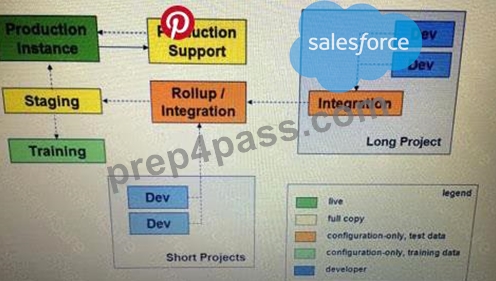
- A. The Staging sandbox is automatically refreshed on a schedule set by the administrator
- B. Salesforce major releases (e.g., Winter to Spring) always occur in Staging and Production at the same time
- C. The Staging environment can only be updated once every two weeks
- D. When created or refreshed, the Staging sandbox is a full replica of Production
Answer: D
Explanation:
Explanation
The correct statement for the Staging sandbox in the diagram is that when created or refreshed, the Staging sandbox is a full replica of Production, as it is a full copy sandbox that copies all the data and metadata from the production org. Option B is not true, as the Staging sandbox is not automatically refreshed, but manually refreshed by the administrator. Option C is not true, as Salesforce major releases may occur in Staging and Production at different times, depending on the sandbox preview window. Option D is not true, as the Staging environment can be updated more frequently than once every two weeks, depending on the sandbox refresh interval.
NEW QUESTION # 135
Universal containers have recently replaced a custom service center application with Salesforce Service Cloud. Administrators are now confused about which fields and classes are actively being utilized and how future implementations can be maintained. Choose 2 answers
- A. Create a design standard requiring integration to use declarative configurations patterns
- B. Create an adoption plan for end users using Salesforce dashboards and reports.
- C. Create a standard method for deprecating classes and fields using design standards.
- D. Create a governance process requiring all projects to create project deliverable documentation.
- E. Create a governance framework focused on high-level business strategy and goals.
Answer: C,D
NEW QUESTION # 136
Universal Containers (UC) is using sales and service Cloud. They have two major releases and four minor releases every year. They have deployment (dev), integration, user acceptance (UAT), staging, and hotflix sandboxes. What should an Architect recommend when UC has PI issues and has to be fixed immediately?
- A. Fix the issue in hotflix, test, and deploy to production.
- B. Fix the issue in staging and deploy it into production.
- C. Follow the release management process to move to production.
- D. Fix the issue in development, test, UAT, and deploy to production.
Answer: A
Explanation:
Explanation
Fixing the issue in hotfix, testing, and deploying to production is the best option when UC has PI issues and has to be fixed immediately. A hotfix sandbox is a type of sandbox that is used for emergency fixes in production. It is a copy of the production org and has a shorter refresh interval than other sandboxes. A hotfix sandbox allows the team to quickly fix and test the issue without affecting the ongoing development and release cycles.
NEW QUESTION # 137
Universal Containers has multiple project teams integrating Salesforce to various systems Integration Architects are complaining about the various integration patterns used by the teams and lack a common understanding of the integration landscape. What should architect recommended to address the challenges?
- A. Recommend an outbound message design pattern to be used for all teams.
- B. Create design standards focused on integration and provide training to all teams
- C. Recommend a fire-and-forget design pattern to be used for all teams.
- D. Implement a data governance policy and publish the documentation to all teams.
Answer: B
Explanation:
Explanation
Creating design standards focused on integration and providing training to all teams is the best way to address the challenges of having various integration patterns and a lack of common understanding of the integration landscape. Design standards can help to establish consistent and best practices for integrating Salesforce with other systems, such as choosing the appropriate integration style, pattern, tool, and protocol. Training can help to educate and align the teams on the design standards and the integration architecture.
NEW QUESTION # 138
Universal Containers CUC) has been on the org development model with scratch orgs are already enabled, but they haven't been taking advantage of the scratch orgs.
Now UC is ready to move to the package development model.
What step must be done by an administrator?
- A. In setup, switch the Enable Dev Hub to Enabled, then switch the Enable Source Tracking for Scratch Orgs to Enabled.
- B. In setup, switch the Enable Unlocked Packages to Enabled, keep the Enable Second-Generation Managed Packages as disabled.
- C. In setup, switch both the Enable Dev Hub and Enable 2nd-Generation Managed Packages to Enabled.
- D. In setup, switch the Enable Unlocked Packages and Second-Generation Managed Packages to Enabled.
Answer: A
NEW QUESTION # 139
Universal Containers (UC) is implementing a governance framework and has asked the Architect to make recommendations regarding release planning. Which two decisions should the Architect make when planning for releases? Choose 2 answers
- A. How to roll back to the previous Salesforce release if there are issues.
- B. How to test existing functionality to ensure no regressions are introduced.
- C. Whether Salesforce will wait to upgrade the pod until after a UC release is complete.
- D. When to test a new UC feature release if there are issues.
Answer: B,D
Explanation:
Explanation
How to test existing functionality to ensure no regressions are introduced is a decision that the Architect should make when planning for releases, as it is part of the quality assurance process and helps to ensure that the new changes do not break the existing functionality. When to test a new UC feature release is also a decision that the Architect should make when planning for releases, as it is part of the release schedule and helps to coordinate the testing activities with the development and deployment activities. Whether Salesforce will wait to upgrade the pod until after a UC release is complete is not a decision that the Architect can make, as it is determined by Salesforce and depends on the release window and the pod assignment. How to roll back to the previous Salesforce release if there are issues is not a decision that the Architect can make, as it is not possible to roll back to a previous Salesforce release once the upgrade is done.
NEW QUESTION # 140
Universal Containers is having trouble deploying metadata from SIT to UAT. UAT is complaining that it does not recognize some new Salesforce metadata types to be deployed. The deployment from Dev to SIT worked perfectly What could be the problem?
- A. UAT is on a preview release and SIT is not.
- B. SIT is on a preview release and UAT is not.
- C. Use the DX command line instead.
- D. There is no problem, this is expected behavior.
Answer: A
Explanation:
Explanation
The problem is that UAT is on a preview release and SIT is not. A preview release is a version of Salesforce that contains the features and enhancements that will be available in the next major release. Preview releases are usually available a few weeks before the official release date, and they are assigned to a subset of instances. If UAT and SIT are on different instances, they may have different release versions, which can cause deployment issues. For example, if UAT has a preview release that contains some new metadata types that are not available in SIT, then deploying those metadata types from SIT to UAT will fail. To avoid this problem, the architect should check the Sandbox Preview Guide1 and the Release Notes2 to see if there are any changes that affect the deployment, and refresh and redeploy the sandboxes accordingly. There is a problem, and it is not expected behavior. Using the DX command line instead will not solve the problem, as it will still encounter the same version mismatch. SIT is not on a preview release and UAT is not, as that would not cause any deployment issues.
NEW QUESTION # 141
Universal Containers (UC) has gone through a global organization restructuring and process review during the last year, which triggered a review of its Salesforce org strategy. After thorough analysis of its org and global customers, UC decided to start a project to merge its Salesforce orgs, going from a multi-org to a single-org strategy.
In this scenario, what are three benefits going to a single-org strategy?
Choose 3 answers
- A. Lower administration overhead costs.
- B. Easier to get a 360-view of the customer.
- C. Automatically unify data model among all lines of business.
- D. Consolidating the business processes would be simplified.
- E. Improved Chatter collaboration across different business units.
Answer: A,B,E
Explanation:
Explanation
Going to a single-org strategy can provide several benefits, such as lower administration overhead costs, improved Chatter collaboration across different business units, and easier to get a 360-view of the customer.
Consolidating the business processes and unifying the data model among all lines of business are not benefits of a single-org strategy, but rather challenges that need to be addressed during the org merge process.
NEW QUESTION # 142
Universal Containers has five development teams. The performance of the teams has been good, but the number of bugs has been increasing. After each sprint, they need more time to understand the code and make changes.
What are two ways to improve the performance?
Choose 2 answers
- A. Sprint review process.
- B. Define a team that will analyze/approve all changes.
- C. Version control system to identify who is generating the bugs.
- D. Define and follow code standards.
Answer: A,D
NEW QUESTION # 143
Universal Containers has just initiated a project involving a large distributed development and testing team. The development team members need access to a tool to manage requirements and the testing team needs access to a tool to manage defects. Additionally, stakeholders are requesting ad -hoc status reports. What tool should an Architect recommend to support the project?
- A. Wave
- B. Spreadsheets
- C. Port management tool
- D. Code Repository
Answer: C
NEW QUESTION # 144
Cloud Kicks (CK) is launching a new sneaker line during the upcoming holiday season and needs to do a thorough batch data testing before Go-Live. CK is using Salesforce unlimited edition.
What two sandbox types should the architect recommend for batch data testing?
Choose 2 answers
- A. Partial Copy sandbox
- B. Developer Pro sandbox
- C. Developer sandbox
- D. Full sandbox
Answer: A,D
NEW QUESTION # 145
......
Prepare For The Development-Lifecycle-and-Deployment-Architect Question Papers In Advance: https://www.prep4pass.com/Development-Lifecycle-and-Deployment-Architect_exam-braindumps.html
Released Salesforce Development-Lifecycle-and-Deployment-Architect Updated Questions PDF: https://drive.google.com/open?id=1fwhAoxHS9YJdWBbiV3nTkggq71DZhG0z
