

350-501 Practice Test Give You First Time Success with 100% Money Back Guarantee!
All Obstacles During 350-501 Exam Preparation with 350-501 Real Test Questions
The Cisco 350-501 exam is a 120-minute test that consists of 60-70 questions. It is a challenging exam that requires a deep understanding of the topics covered. The exam questions are designed to test your knowledge and skills in real-world scenarios, so it is important to have hands-on experience in implementing and operating Cisco Service Provider Network Core Technologies.
NEW QUESTION # 154
Refer to the exhibit.
Router 4 is added to the network and must be in the same area as router 1. Which NET should the engineer assign?
- A. 49.0111.0000.0000.0001.00
- B. 49.0011.0000.0000.0002.00
- C. 49.0011.0000.0000.0003.00
- D. 49.0001.0000.0000.0004.00
Answer: C
NEW QUESTION # 155
Whtch two routing protocols support Cisco MPLS TE tunnels? (Choose two.)
- A. IS-IS
- B. BGP
- C. EIGRP
- D. OSPF
- E. RIP
Answer: A,D
NEW QUESTION # 156
Refer to the exhibit:
Which configuration prevents the OSPF neighbor from establishing?
- A. default-metric
- B. network statement
- C. mtu
- D. duplex
Answer: C
NEW QUESTION # 157
Refer to the exhibit. A network administrator implemented MPLS LDP changes on PE-A LSR device. The engineer must ensure there are no LDP peer are fully operational.
Which LDP feature must the engineer apply to the existing configuration to eliminate the problem?
- A. Enable LDP session protection under the routing protocol.
- B. Configure MPLS LDP IGP synchronization on the network.
- C. Disable IP CEF on routers LDP and enable
- D. Configure MPLS LDP NSR for all LDP sessions.
Answer: D
Explanation:
https://www.cisco.com/c/en/us/td/docs/ios-xml/ios/msp/configuration/xe-3s/mp-ha-xe-3s-book/mp- nsr-ldp-supp.pdf
NEW QUESTION # 158 
Refer to the exhibit. A network operator recently configured BGP FlowSpec for the internal IT network. What will be inferred from the configuration deployed on the network?
- A. The policy is learned via BGP FlowSpec and has active traffic
- B. The policy is learned via BGP FlowSpec and drops all traffic for TCP ports 80 and 443
- C. The policy is configured locally on CSR1 and drops all traffic for TCP ports 80 and 443
- D. The policy is configured locally on CSR1 and currently has no active traffic
Answer: C
Explanation:
Section: Architecture
NEW QUESTION # 159
Drag and drop the functions from the left onto the correct Path Computation Element Protocol roles on the right
Answer:
Explanation: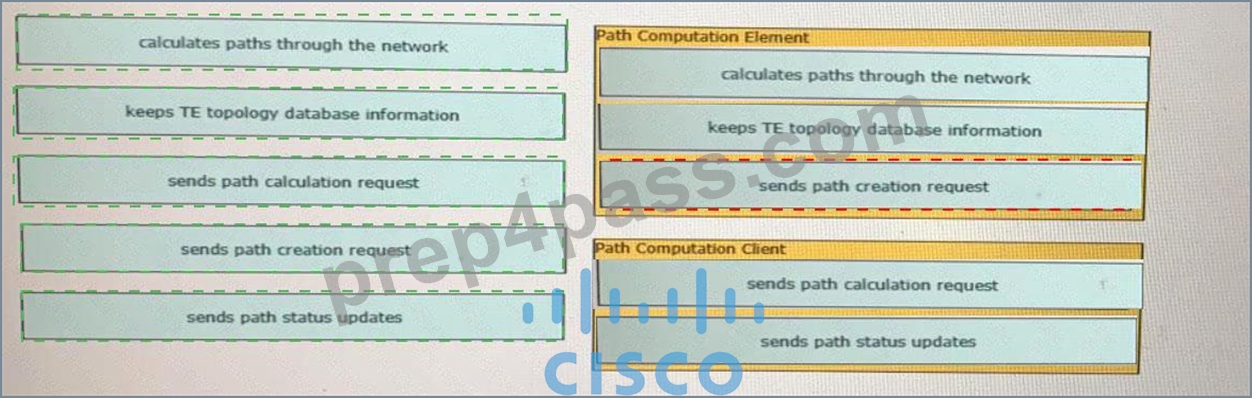
Explanation
Path Computation Element (Calculates paths through the network, keeps TE topology database information, sends path status updates) Path computation Client (sends path calculation request, sends path creation request) Path Computation Element (PCE) Represents a software module (which can be a component or application) that enables the router to compute paths applying a set of constraints between any pair of nodes within the router's TE topology database. PCEs are discovered through IGP.
Path Computation Client (PCC)
Represents a software module running on a router that is capable of sending and receiving path computation requests and responses to and from PCEs. The PCC is typically an LSR (Label Switching Router).
https://www.cisco.com/c/en/us/td/docs/routers/crs/software/crs_r5-3/mpls/configuration/guide/b-mpls-cg53x-crs
NEW QUESTION # 160
Drag and drop the descriptions from the left onto the corresponding OS types on the right.
Answer:
Explanation:
Explanation
IOS XE:
It uses linux-based kernel
It has a separate control plane
IOS:
It is monolithic
It shares memory space
NEW QUESTION # 161
After a series of unexpected device failures on the network, a Cisco engineer is deploying NSF on the network devices so that packets continue to be forwarded during switchovers. The network devices reside in the same building, but they are physically separated into two different data centers. Which task must the engineer perform as part of the deployment?
- A. implement OSPF to maintain the link-state database during failover.
- B. implement VRFs ana specify the forwarding instances that must remain active during failover.
- C. implement an L2VPN with the failover peer to share state Information between the active and standby devices.
- D. implement Cisco Express Forwarding to provide forwarding during failover
Answer: C
NEW QUESTION # 162
Refer to the exhibit. An engineer is preparing to implement data plane security configurating. What os the result of this configuration?
- A. Router 2 is the router receiving the DDoS attack.
- B. Router 1 is the trigger router in a RTBH Implementation.
- C. Router 2 must configure a route to nul 0 for network 192.108.1.0/24 for the RTBH implementation to be complete.
- D. Router 1 must be configured with uRPF for the RTBH Implementation to be effective.
Answer: B
NEW QUESTION # 163
A new PE router is configured to run OSPF as an IGP with LDP on all interfaces. The engineer is trying to prevent black holes after convergence when the PERSON device loses an LDP session with other PE routers. Which action must the engineer take to implement LDP session protection on a new PE router?
- A. Configure the mpls ldp session protection and mpls label protocol ldp commands on the interfaces on the new PE router that connect to the CENTER routers.
- B. Configure the new PE router with the mpls ldp session protection command and on neighboring routers that connect to this new PE router.
- C. Configure the mpls ldp discovery targeted-hello accept and mpls ldp session protection commands on the interfaces on the new PE router that connect to the CE routers.
- D. Configure the new PE router with the mpls ldp session protection command on interfaces with directly connected neighbors.
Answer: B
NEW QUESTION # 164
Refer to the exhibit:
It the NetFlow configuration is updated to version 9, which additional piece of information can be reported"?
- A. IPv6 flow information
- B. BGP AS information
- C. flow sequence numbers
- D. IPv4 flow information
Answer: A
NEW QUESTION # 165
Refer to the exhibit:
What is the effect of this configuration?
- A. The two routers fail to form a neighbor relationship because their system IDs are different.
- B. The two routers fail to form a neighbor relationship because the authentication configuration is missing
- C. The two routers successfully form a neighbor relationship
- D. The two routers fail to form a neighbor relationship because they have different ISIS area types.
Answer: C
NEW QUESTION # 166
Drag and drop the descriptions from the left onto the corresponding OS types on the right.
Answer:
Explanation:
NEW QUESTION # 167
Refer to the exhibit.
Which two topology changes happen to the IS-IS routers? (Choose two.)
- A. R1 and R2 are Level 2 neighbors.
- B. All four routers are operating as Level 1 routers only.
- C. R1 and R4 are Level 2 neighbors.
- D. All four routers are operating as Level 1-2 routers.
- E. All four routers are operating as Level 2 routers only.
Answer: A,D
NEW QUESTION # 168
After implement MPLS protocol for multiple VRFs on a single Cisco device, the engineer notices all VRFs on the router still do to not LDP session protection feature enabled. When configuration must the engineer apply to enable the LDP session protection feature FOR LDP neighbors within each VRF?
- A. Configure LDP session protection within the individual VRFs.
- B. Configure LDP session authentication on the device to enable LDP session protection on each VRF automatically
- C. Configure LDP session protection globally on the device only.
- D. Configure LDP session protection globally on the device and on each neighbor that requires session protection.
Answer: A
NEW QUESTION # 169
Refer to the exhibit.
Which configuration must be applied to each of the four routers on the network to reduce LDP LIB size and advertise label bindings for the /32 loopback IP space only?
- A. Option A
- B. Option C
- C. Option D
- D. Option B
Answer: A
NEW QUESTION # 170
Refer to the exhibit:
A network engineer is implementing an OSPF configuration Based on the output, which statement is true?
- A. OSPFv3 cannot be configured for IPv4; OSPFv3 works only for IPv6.
- B. In the ospfv3 1 area 1 ipv4 command, area 0 must be configured instead of area 1.
- C. IPv6 routing not enabled" is just an informational message and OSPFv3 runs for IPv4 on interface FastEthernet0/0 anyway
- D. OSPFv3 does not run for IPv4 on FastEthemet0/0 until IPv6 routing is enabled on the router and IPv6 is enabled on interface Fastfc.thernet0/0
Answer: D
NEW QUESTION # 171
A network engineer Is implementing a QoS policy for outbound management traffic classification and marking on a CPE device with these requirements:
A network engineer Is implementing a QoS policy for outbound management traffic classification and marking on a CPE device with these requirements
* Management protocols must be marked with DSCP AF class 2 w4h low drop probability.
* Monitoring protocols must be marked with DSCP AF class 1 with low drop probability.
* All remaining traffic must be marked with a DSCP value of 0.
Which configuration must the engineer implement to satisfy the requirements?
A)
B)
C)
D)
- A. Option A
- B. Option C
- C. Option D
- D. Option B
Answer: B
Explanation:
https://www.cisco.com/c/en/us/td/docs/switches/datacenter/nexus1000/sw/4_0/qos/configuration/guide/nexus1000v_qos/qos_6dscp_val.pdf
NEW QUESTION # 172
Refer to the exhibit:
Which effect of this configuration is true?
- A. The two routers fail to form a neighbor relationship because their system IDs are different.
- B. The two routers fail to form a neighbor relationship because the authentication configuration is missing
- C. The two routers successfully form a neighbor relationship
- D. The two routers fail to form a neighbor relationship because they have different ISIS area types.
Answer: C
NEW QUESTION # 173
An engineer is setting up overlapping VPNs to allow VRF ABC and XYZ to communicate with VRF CENTRAL but wants to make sure that VRF ABC and XYZ cannot communicate. Which configuration accomplishes these objectives?
A)
B)
C)
- A. Option B
- B. Option A
- C. Option C
Answer: A
NEW QUESTION # 174
......
The Cisco 350-501 exam is an opportunity for professionals to demonstrate their expertise in service provider network technologies. This certification can help individuals advance their careers by validating their knowledge and skills in this area. It is also a valuable credential for employers who are looking to hire skilled professionals to work on their service provider networks.
Fully Updated Free Actual Cisco 350-501 Exam Questions: https://www.prep4pass.com/350-501_exam-braindumps.html
Free 350-501 Questions for Cisco 350-501 Exam [Jun-2023]: https://drive.google.com/open?id=1I1NtzBWv2eegQutAi_oPUE5I7F0cOfGY
